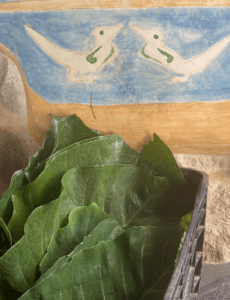
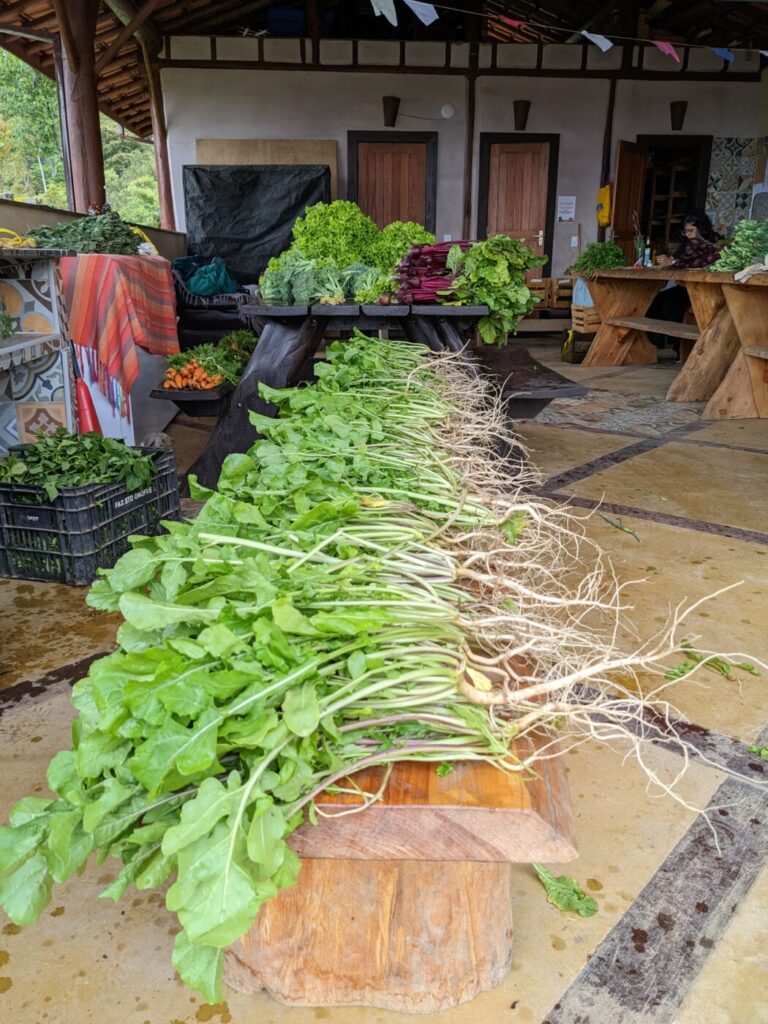
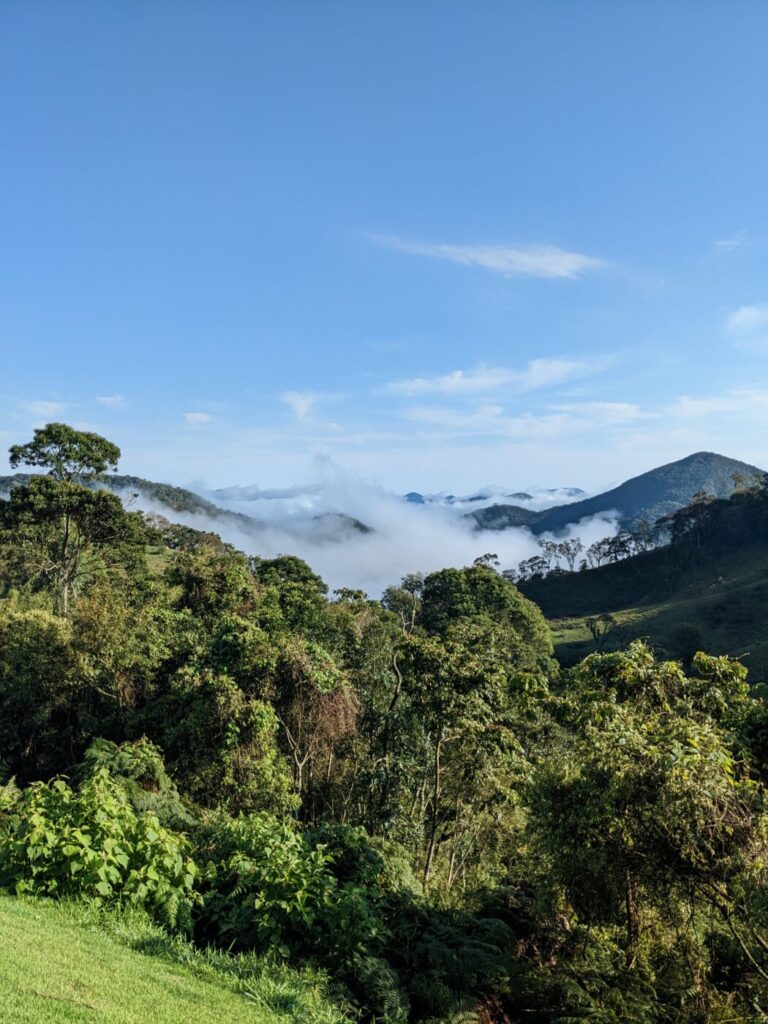
Taioba, a leafy green native to South America, is a key player here at Eco Caminhos farm due to its health benefits and usefulness within agroforestry. This plant can be found in kitchens across Brazil, Africa, and Trinidad and Tobago. In this article, we will explore the wonders of taioba, from its ecological role to its culinary applications.
Taioba and the Agroforestry System
Taioba (Xanthosoma sagittifolium) serves various functions within agroforestry systems. Amidst the diversity of plants, taioba not only thrives, but also helps maintain soil moisture and protect against erosion, thanks to its large leaves. Taioba leaves act as a living mulch, helping to keep the soil fluffy and moist. This characteristic is essential for protecting tree roots and providing shade for small coffee seedlings, creating a more favorable environment for their initial development. Its presence contributes significantly to the health of the ecosystem, promoting biological diversity and agricultural sustainability.
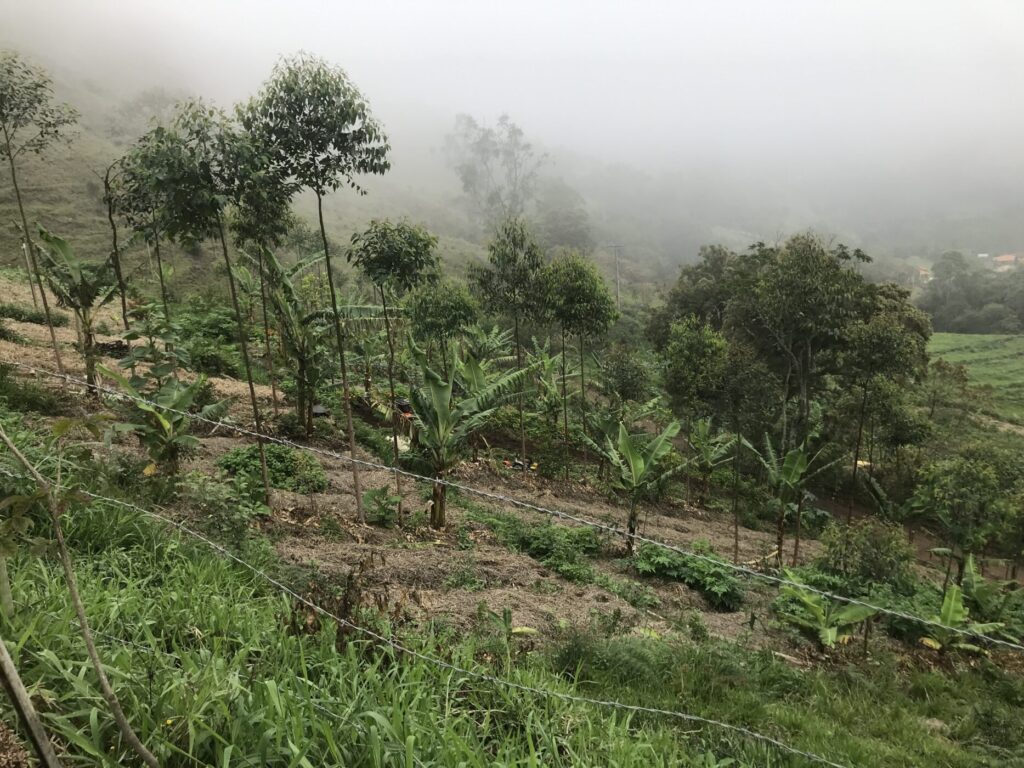
In the pictures to the right you can see our agroforestry systems (SAF) at different stages. In the newly planted SAF (left), it is easy to see how taioba creates shade for the coffee seedling below. The more mature SAF (right) shows inhame which serves a similar role as the taioba amongst a larger diversity of more mature plants. Be warned that the inhame leaf, while similar in appearance and function within agroforestry to the taioba, is not safe for consumption; however, inhame root is edible and delicious.
See how taioba interacts with other plants in a five month old agroforestry systemThe inhame plays a similar role to taioba here in this mature agroforestry system
Health Benefits & Preparation
In addition to its functions within an agroforestry system, taioba is a rich source of essential nutrients. Rich in vitamins A and C, calcium, and iron, taioba offers significant health benefits, including strengthening the immune system, promoting eye health and maintaining healthy bones and teeth. Furthermore, its low calories make it an excellent food to include in balanced diets.
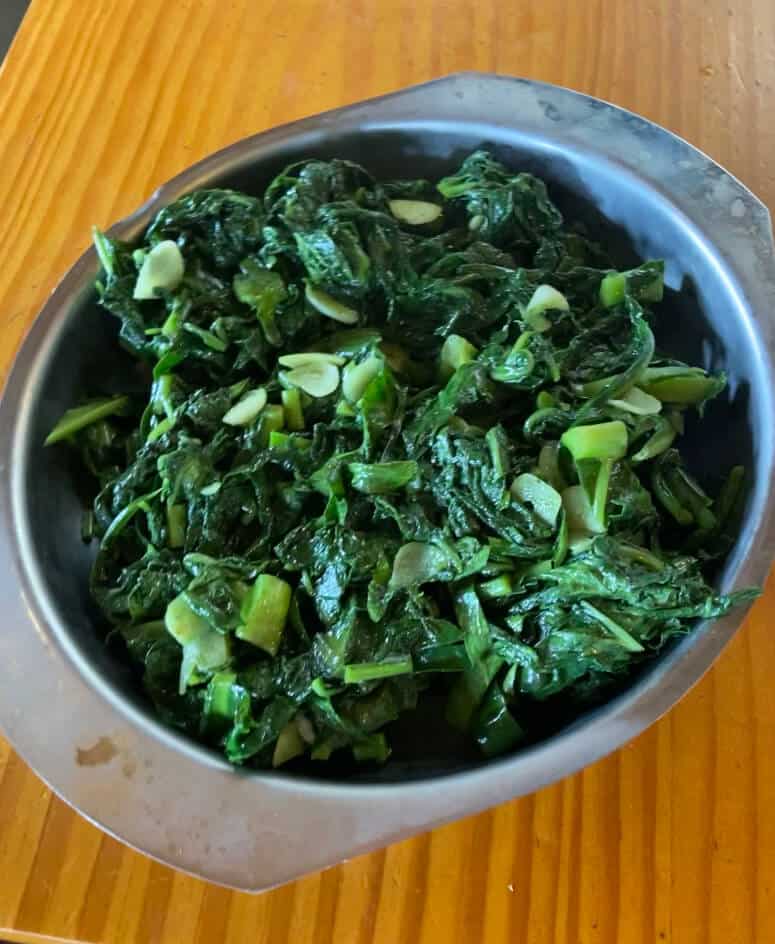
However, taioba requires proper preparation because it contains oxalic acid. Oxalic acid is also found in foods like spinach and other leafy green vegetables. When consumed in large quantities, oxalic acid can cause irritation to the mucous membranes. Proper preparation of taioba, mainly through cooking, nullifies these adverse effects, making it safe for consumption. Traditionally taioba leaves are consumed cooked in stews, soups, or pies. When cooked, this leafy green has a mild and pleasant flavor.
Taioba Refogada (Stir-fry) Recipe
Ingredients:
1 bunch of taioba (1o leaves)
2 cloves of garlic
2 tablespoons of olive oil
Salt to taste
Steps:
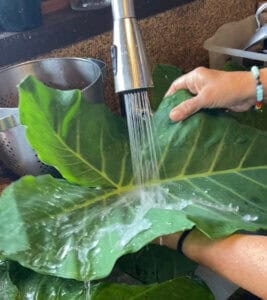
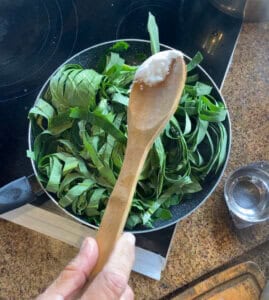
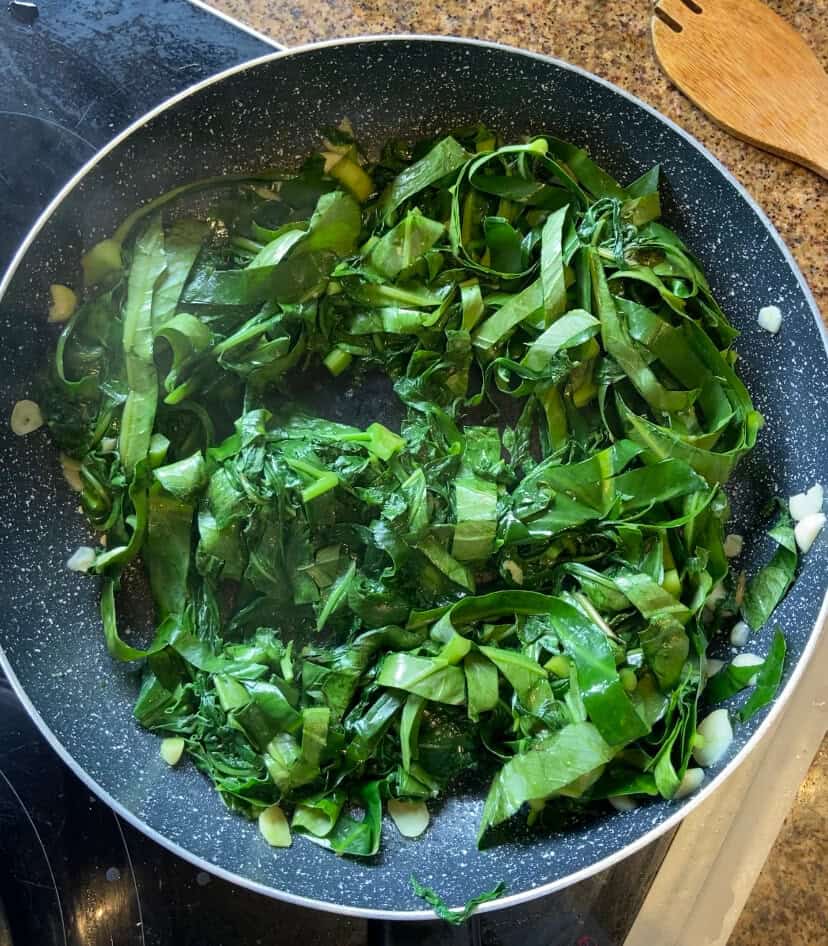
Wash the leaves well under running water to remove any dirt or residue.
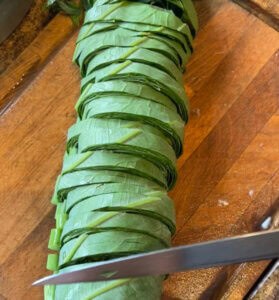
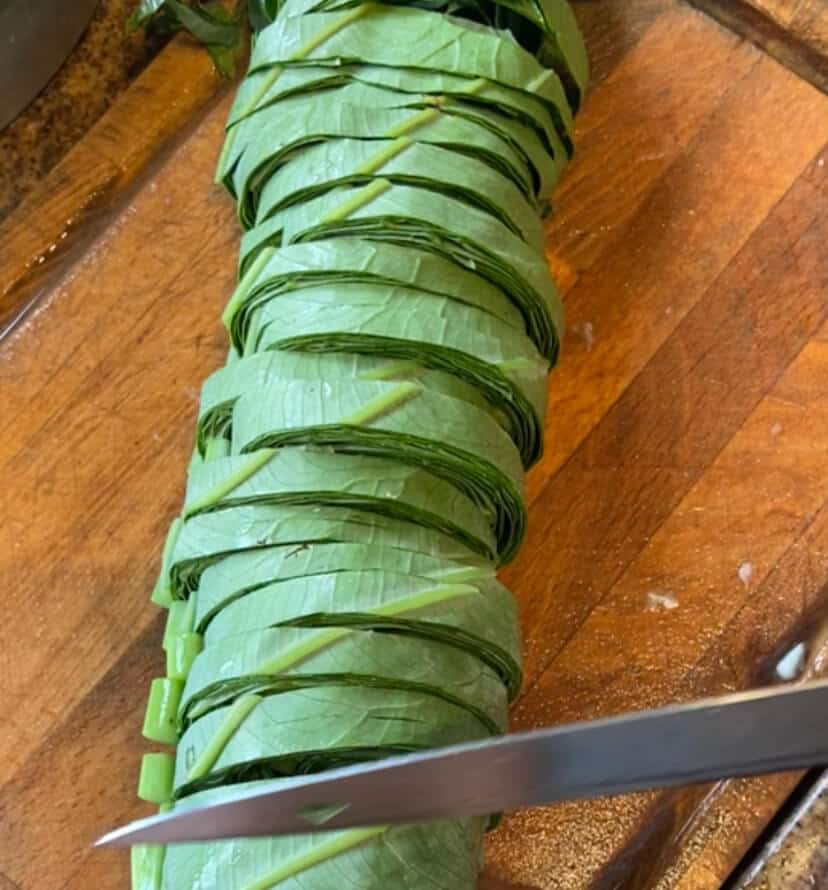
Remove the stalk and cut into strips or pieces.
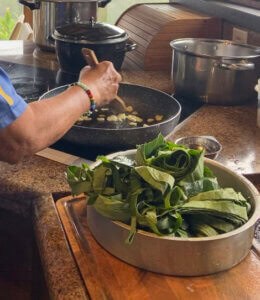
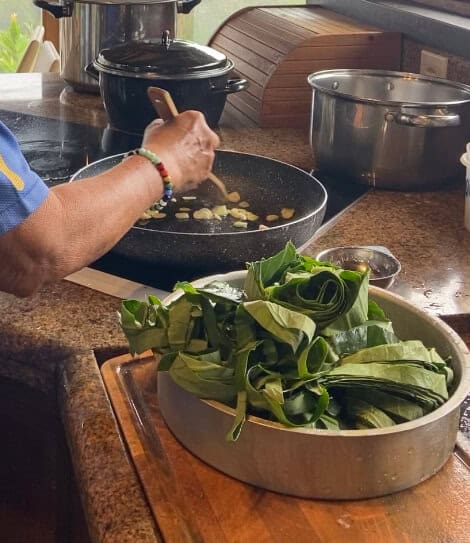
Saute garlic in olive oil over medium heat until fragrant.
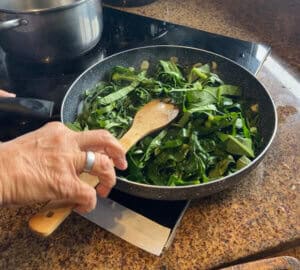
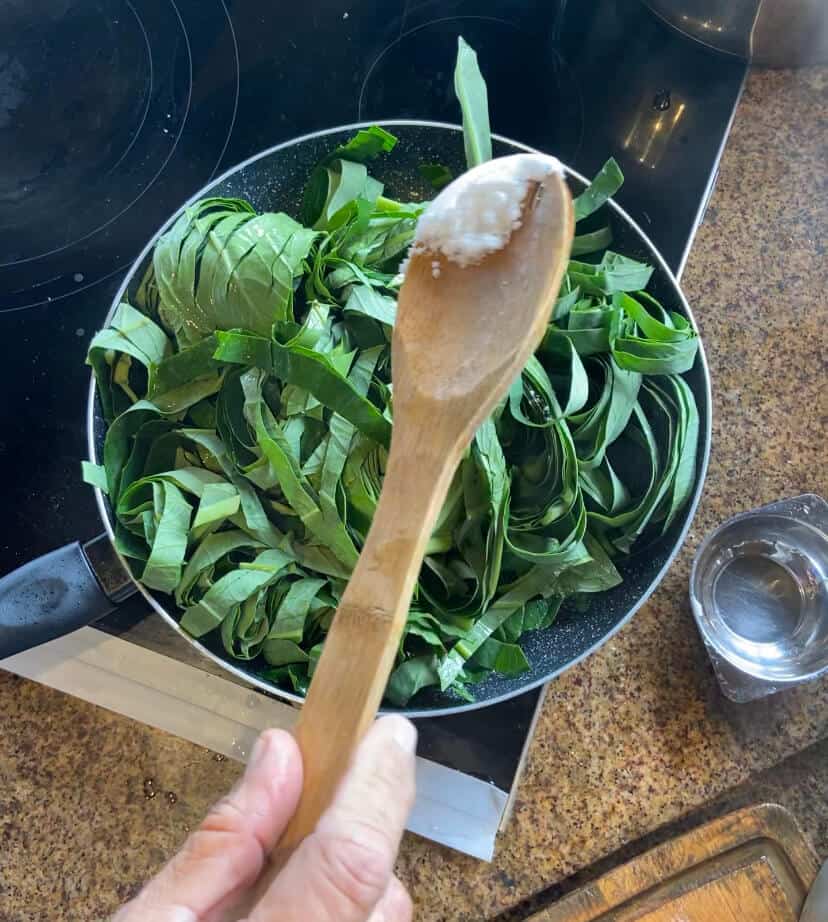
Add in the taioba and salt to taste.
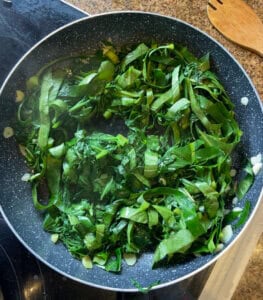
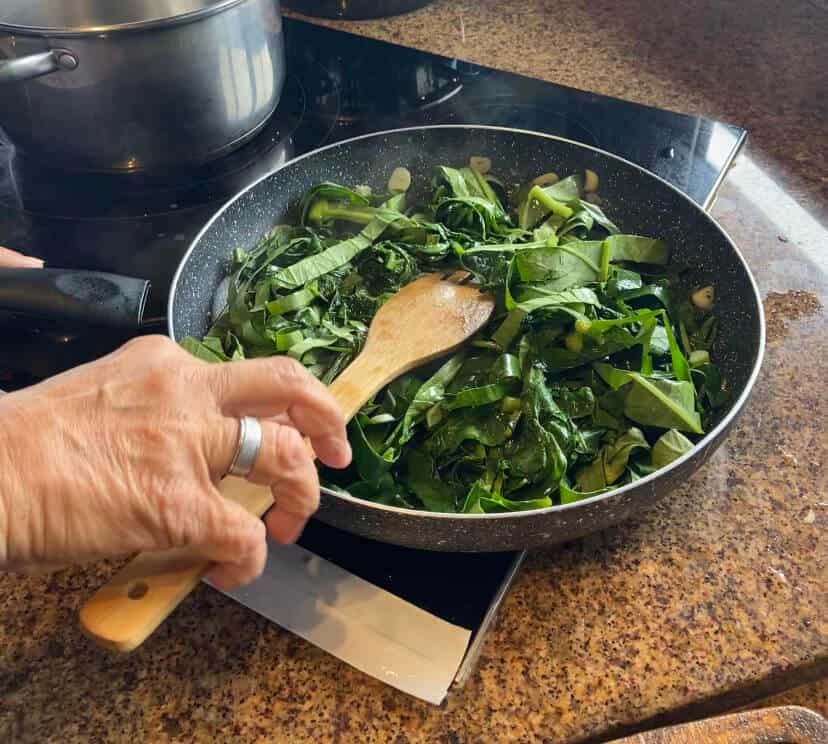
Stir occasionally, until the taioba has reduced to about half of its original volume.
After the taioba has reduced to 50% of its original volume, turn the heat to low.
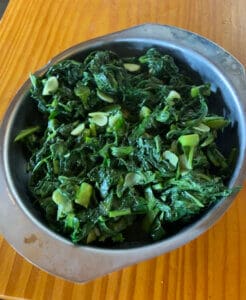
When the taioba has cooked down to a texture reminiscent of cooked spinach, it’s ready to serve and enjoy!
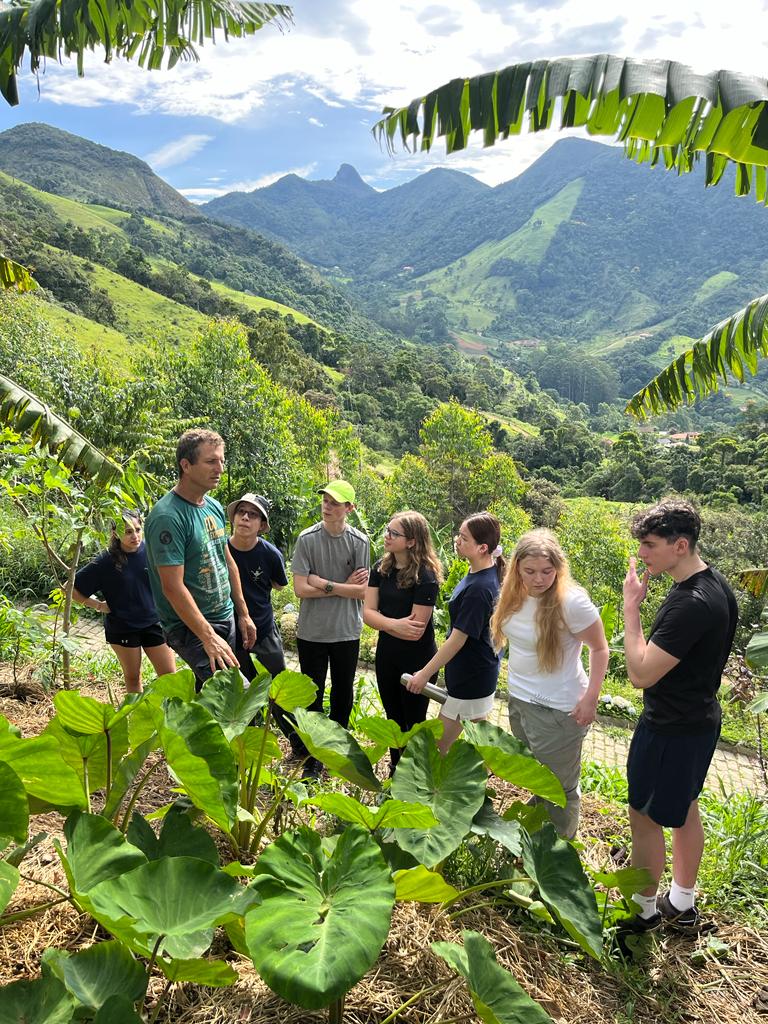
Coming from Canada direct to the neighborhood of Cordoeira – participate in an action in local school, build park and participate in bioconstruction and agroforestry project in partnership with ‘Eco Caminhos’.
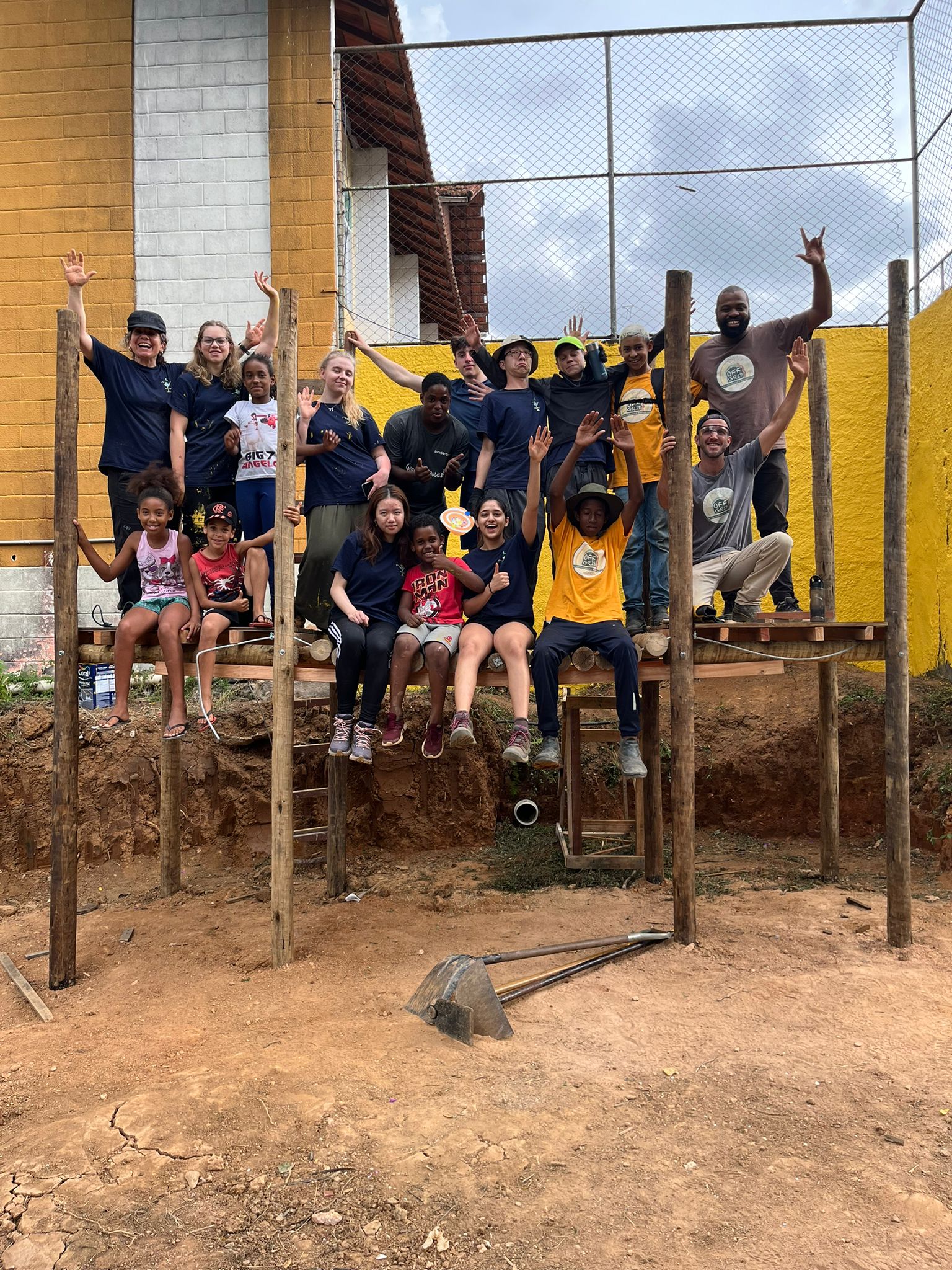
In partnership with the social program OFFGRID we are pleased to welcome a group of students from sainteanne school in Canada to help us build a playground in a school in Nova Friburgo – Padre Rafael Municipal School, in the Cordoeira neighborhood.
They came to help us with a lot of love, passion, enthusiasm and happiness spreading throughout our community and also giving us a hand in the mass in our permaculture project at Eco Caminhos.
They are from many parts of the globe we have Hungarians, Russians, Spanish, Indians, Chinese, Italians, English and French all together on a mission that began on Monday, 6, where they will remain until March 22.
This is a great opportunity for them to learn a new language like Portuguese and also about different cultures and customs.
Bart points out that the experience is rich for both students coming from other countries and young Brazilians:
“Here they have the opportunity to know a foreign language and understand that young people on the other side of the world are equal, are only from another culture, with different race and language, but have many similar things and make us believe that the world is much smaller than we imagine”.
The financial resources for the construction of the School Park were part of a donation from the students and they are acting as volunteers. It’s a wonderful gesture!
The OFFGRID project is a bilingual project that follows the vision of development of children and young people through humanized sustainable habits and skills.
João Guilherme Wermelinger, dentist who participates in the ‘Off Grid’ project at Padre Rafael school said he is full of expectations:
“I’m sure it will be days of discovery, hope, diversity and inclusions, served by altruism and also empathy”.
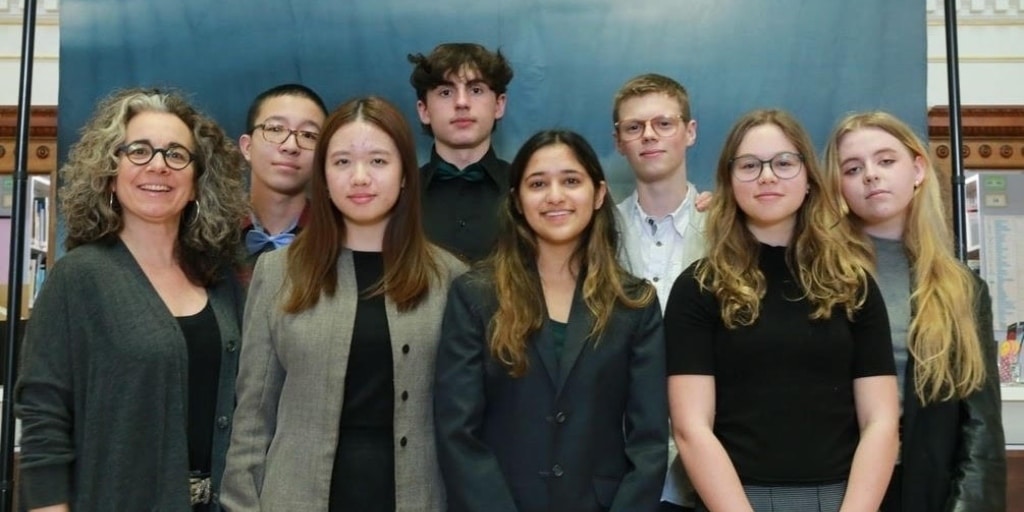
The seven young students from different corners of the world are accompanied by a teacher and will also produce a documentary on sustainable tourism, which is part of the completion of their school program.
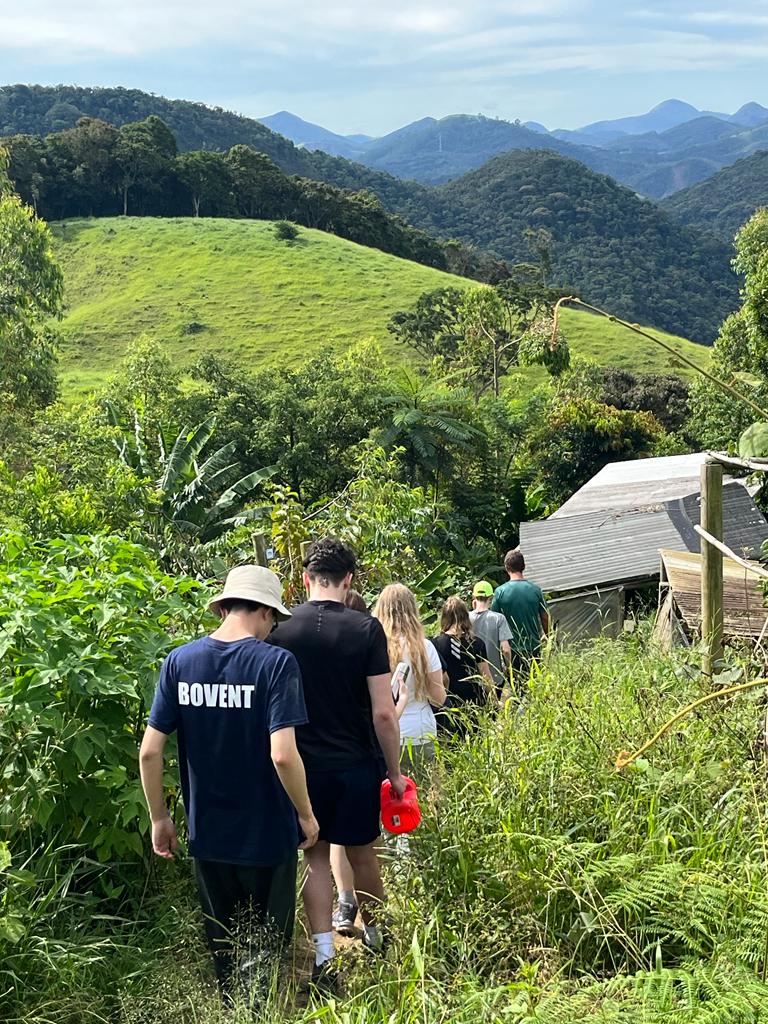
In addition to the interventions and benefits of the school in Cordoeira, students will have agroforestry experiences, will learn about Bioconstruction, as well as leisure activities such as trails, and walks in waterfalls of the city.
Opportunities like this are extremely important both for young foreigners who come to make an exchange in Brazilian lands and for the young people here, who start to see more possibilities for a better future, the importance of taking care of our environment using sustainable practices for the greater good of the community and the planet in which we live. It is a fact that this immersion will provide a new worldview to these young people and we believe that we are following the right path in search of a better future.
Rather than approaching life improvement and growing food as a math equation of inputs and outputs, Eco Caminhos practices a philosophy of self-sustaining and self-reinforcing systems.
An Eclectic Crew
Colmeia is Portuguese for “beehive”. It’s a play on words, a double meaning. It functions as the hive of activity. Also, Bart Bijen’s last name means “bees” in Dutch.
At the Eco Caminhos permaculture farm, work begins at seven. The volunteers pile into the back of the pickup to avoid the difficult slog uphill to the heart of the farm. The truck strains up the mountainside in first gear with its human cargo packed in like French fries.
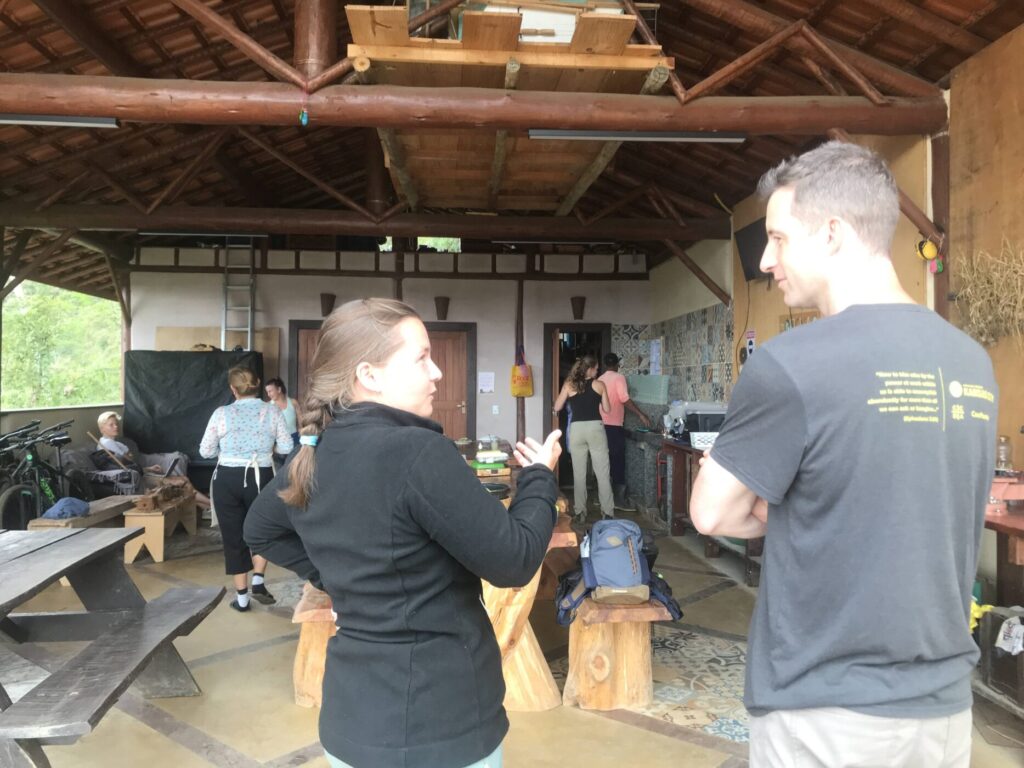
We gather at Colmeia (Portuguese for beehive), where lunch, vegetable processing, and the daily meetings occur.
To call the group of people that report at Colmeia every morning diverse is an understatement. The crowd is downright eclectic.
If our community was a patchwork quilt it would have squares of fine cashmere alongside threadbare long johns. It is quite amazing that we all get along, much less communicate. Yet somehow, that seems to be the point.
An Eclectic Community
The core group of workers on the farm are the apprentices. Bart, the project’s founder and director, has known most of them since earlier days when he ran an orphanage in Rio de Janeiro. Without exception, they come from tough backgrounds and some still struggle with old vices. They are the ones who teach us newcomers and short-termers how to do our tasks.
The volunteers come for as little as a few days or as long as a year or more. They also come from various backgrounds. Since we’ve been here, we’ve worked alongside a retired Brazilian woman, two college-aged Dutch guys (didn’t know each other before coming), an American girl just out of high school, two Italian women architects taking a break from their busy careers in Germany (a total coincidence, they also didn’t know each other before coming), and a Bangladeshi-Canadian family with two boys. Those are just to name a few.
Then there is us: an American family of five. Financially mediocre by U.S. standards, but quite wealthy by Brazilian standards. Traveling abroad for a year. Trying to reset our lives and reimagine our future.
Everyone is here for different reasons and has a range of expectations for the experience. Each volunteer is under different terms and timeframes. Some of us pay handsomely, some stay for free, others are somewhere in between. Some work five days, others three, others have a more flexible schedule. We all come with very different strengths and weaknesses. We give and we receive.
A harvest being processed at Colmeia.
Basics of Agroforestry (From Someone Who’s Never Grown a Garden)
After our opening meeting, we break off into several teams. Most will be tending to the agroforestry. Each apprentice leads a group of short-term volunteers to one of the agroforestry sites. That is where the developed-world city-slickers get schooled in the most basic function of civilization: putting food on the table.
Forget everything you know about planting a garden. This is not your square of dirt, sectioned off with cute labels at the end of each row and ample space between each shoot.
In the simplest terms, agroforestry is agriculture that mimics a forest. The jungle doesn’t section itself off into monocultures. Plants grow (sometimes quite literally) on top of each other. Every tree, vine, and shrub jams itself into wherever there’s a square inch of dirt and a ray of sunshine.
That’s not to say there isn’t order in a natural forest. It’s just not where you’d think to look.
Order in the Forest
Forests order themselves vertically. They grow in stratums.
At the very top, the emergent and high stratums take on the brunt of the sunlight. This is far from a selfless act. These species crave sunlight for photosynthesis. Like a bully that shoves his way to the front of the line, they selfishly shoot up and steal as much sunshine as they can.
Lower stratum species — like this Gringo programmer who hasn’t seen a beach in nine months — will get torched in full sunlight. Species such as coffee thrive in partial shade. I can relate to coffee.
That is just one of the more visible ways that different species support each other. Beneath the surface, root systems communicate and share resources through fungal webs. Some plants fix nutrients in the soil. Others drop their leaves and branches, building the soil and covering it to retain moisture. There are probably ways that plants help each other that humans have yet to observe.
Plant life is indeed mysterious. Each plant in an ecosystem participates in a complex web of giving and receiving. And that web is responsive to systemic threats. It is said that pruning one tree in such a system stimulates growth in other neighboring trees.
We might not be able to decipher it all in a computer model. But by following nature’s lead and planting forests, so the thinking goes, we can recreate nature’s abundance for ourselves.
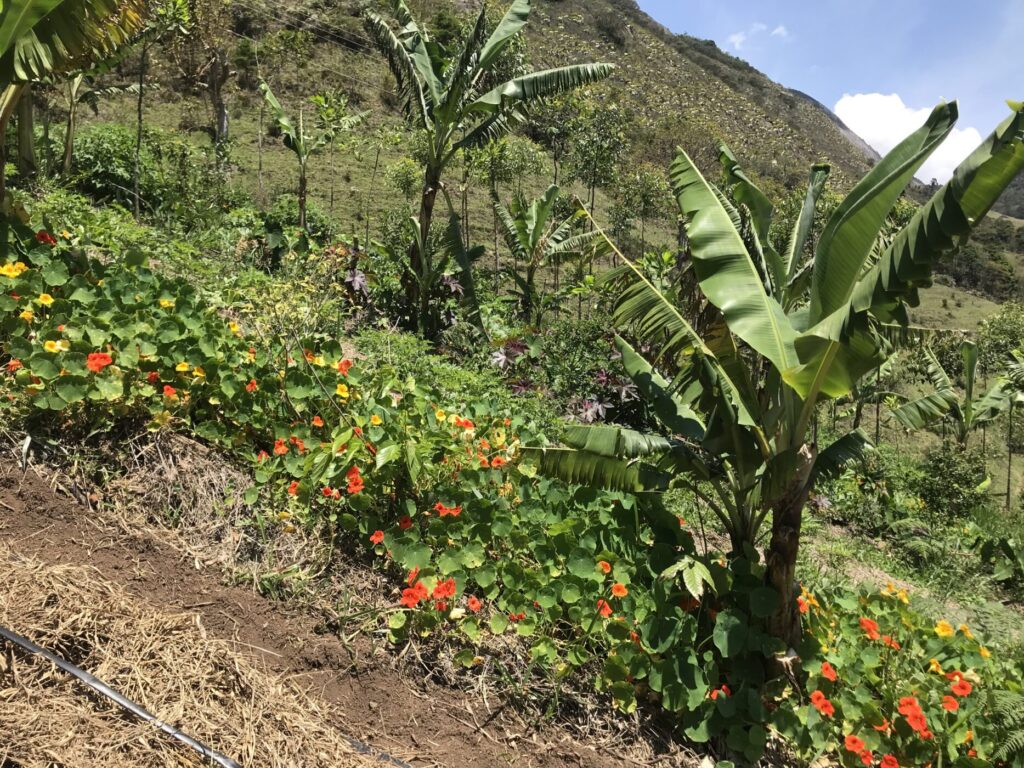
Banana plants, besides producing the fruits we know and love, are the go-to species for making shade because of their broad foliage and rapid growth. Their stems and trunks can also be used as biomass and retain moisture in the soil. They are considered to be in the high stratum.Here we see the towering eucalyptus tree. This is a rapid growing emergent species that protects the soil with its roots and produces excellent hard wood.
Surprising Lessons from Agroforestry
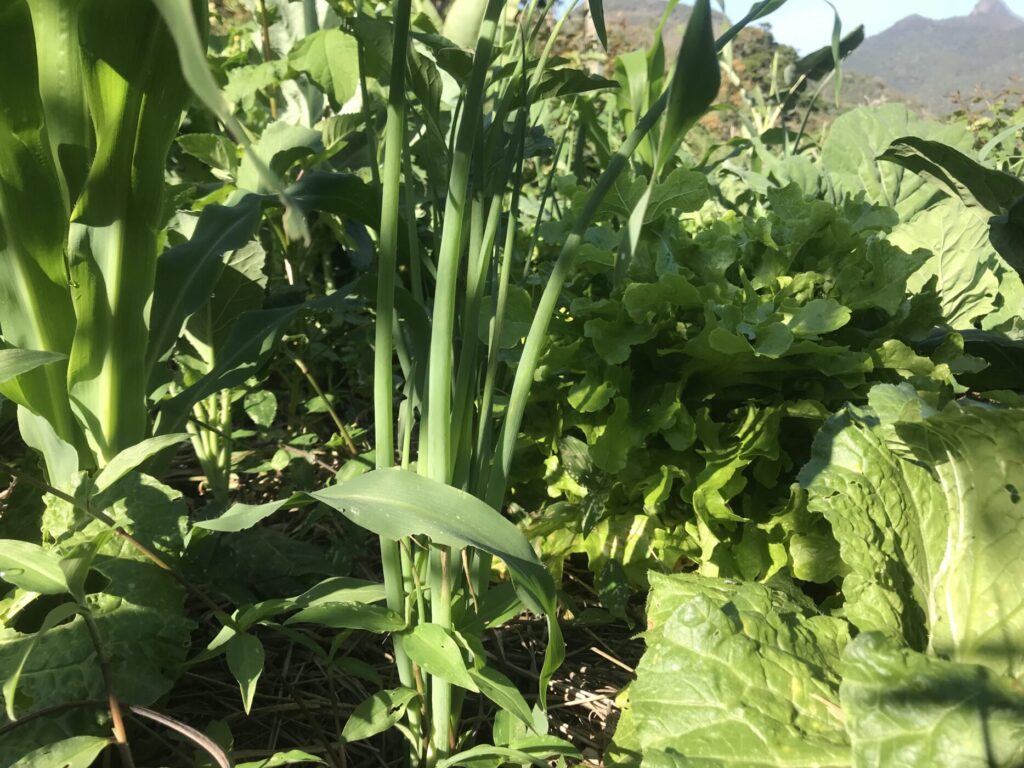
An up-close look at the efficiency, as well as the complexity, of land use, when planting different species together in tight quarters.
The ethos and guiding principle of agroforestry is variety and complexity. Jam as many species into one plot of dirt as possible. Overplant. You can always thin out later and benefit from the added biomass (a fancy term for dead shit and, well, shit).
It violates everything you’ve ever learned about gardening and planting.
It’s hard to fully appreciate the genius of this approach until you are literally down in the weeds tending to it. In my case, I was taking a day away from my usual bioconstruction duties and helping to harvest green onions.
The onions poked their sharp tubular lances up between pavilions of lettuce. Cornstalks towered over the abundant understory, taking the edge off the harshest rays of sunlight.
As I fished around for the base of the onion stalks, I felt the loose humid soil underneath, protected from desiccation by the shade and regenerated by decaying plant matter left from prior pruning, thinning and weeding.
It didn’t take an expert in farming to sense that the soil was healthy and brimming with life. But who can keep up with all that complexity?
Letting Nature Do the Work
On its face, agroforestry seems disastrously complicated to manage. It is the opposite of streamlining and simplification. It strains the mind to remember what is where. All sorts of things are ripening at once in different places. Other places need new seeds. One wonders how it all gets tended with just a handful of volunteers.
But all that complexity comes with a major upside. It takes care of itself. The web of give and take between the plants, the soil, the insects, and the rest of the ecosystem solve their own problems. Nobody has to baby a forest to help it grow and survive. It just does.
Contrast this to a crop I used to see as a child growing up in northern Wisconsin — ginseng. I witnessed fields as far as the eye can see planted with this single lucrative root species. Since its natural niche is the forest floor, farmers manufacture artificial shade using an immense quantity of wood posts to hold up shade cloth. (If you’ve never seen a ginseng field, this article has some good photos).
Planting a single crop of ginseng sounds simple until you consider all the inputs of money, material, and effort required. In other words, you are cutting down a real live forest, transporting it with energy from fossil fuels, and painstakingly building a dead (and ugly) simulation of a forest. It’s expensive. Why not save yourself the work and plant it in a forest! And when you’re done, you still have the trees to harvest for lumber.
Agroforestry does away with artificial inputs and delegates those problems to nature.
Can everybody do it?
So why doesn’t everybody do it. Now!
Not being a farmer, or even a gardener, I’m not in a place to tell conventional farmers what to do. In the long-term, Eco Caminhos hopes to prove itself as a working model for other farmers in the region. But until it can turn a healthy profit off its agroforestry operation, that day must wait. (For now, it makes most of its money from eco-tourism.)
I have my own doubts about agroforestry as an immediate universal solution. While I think they are on to something, I question it’s scalability. If you took the land used for production at Eco Caminhos and figured out how many people it feeds, then extrapolated it to all the farmland in the world, would it meet the world’s needs? I’m not sure and I don’t know if anyone has tried to figure it out. It seems too experimental at the moment to make that leap.
Here is another obstacle. Could a farmer of modest means convert to agroforestry and quickly turn a profit? If the answer is no, then the technique is still only available to hobbyists with cash to invest or as alternate income to ride out the unprofitable years.
But those hobbyists might still be performing a critical function. A person living in the 1950s would have been mistaken to criticize early mainframe computers as impractical for the average consumer. Without that early stage of development, you wouldn’t be reading this post today on the device in your hand or on your lap.
Maybe, one day, my great grandchildren will drive the interstate through my home state of Illinois surrounded by forests instead of cornfields.
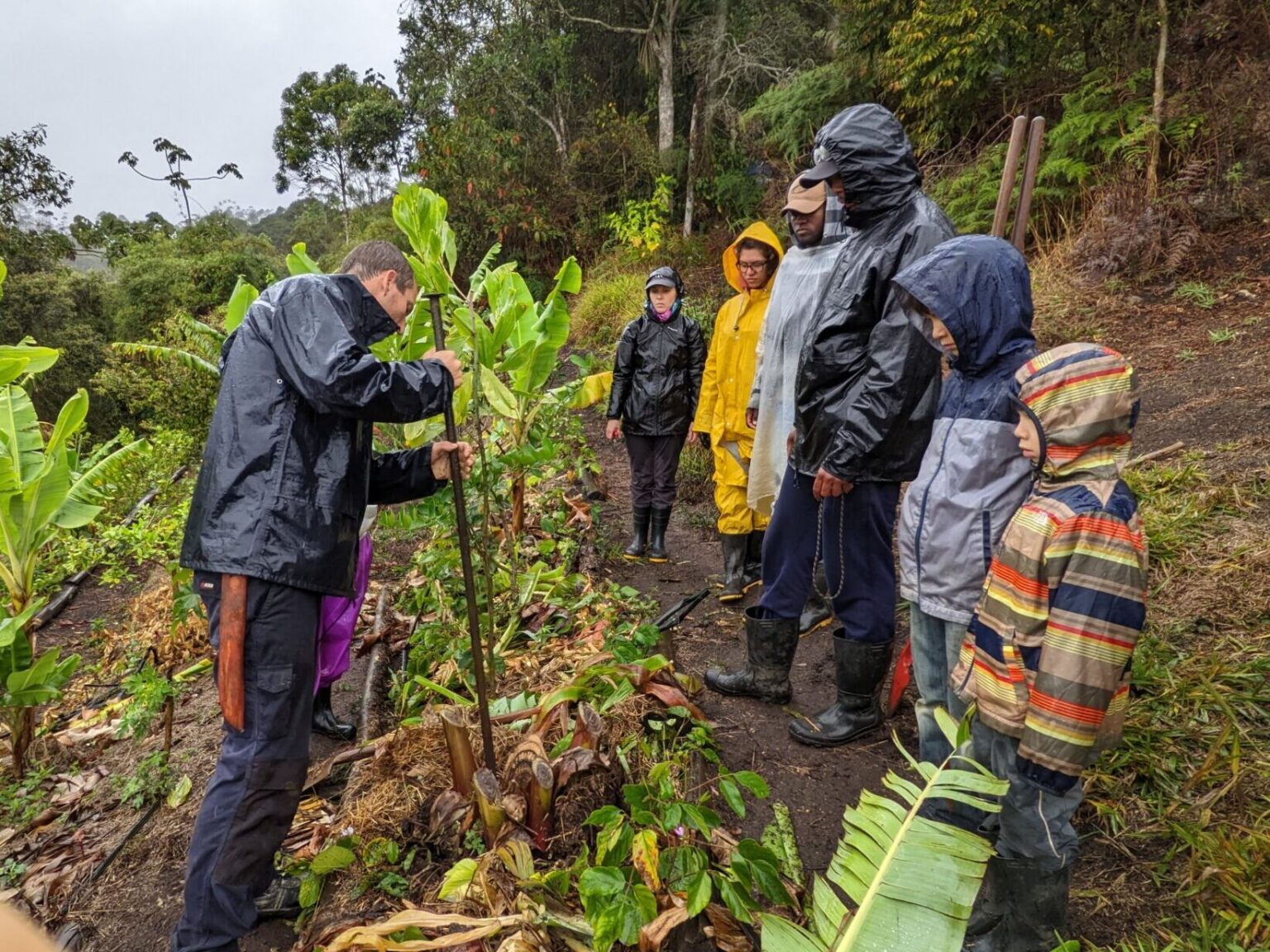
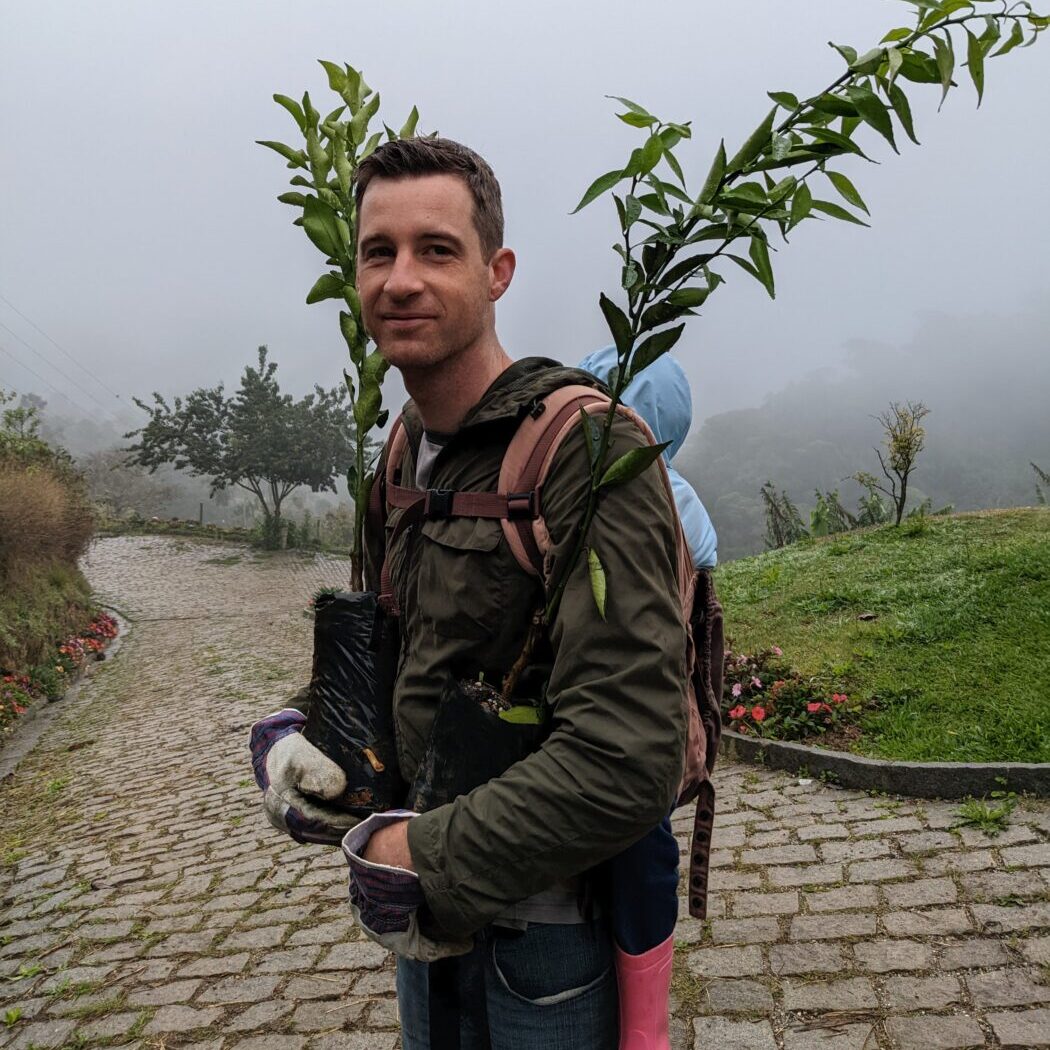
Bart gives a tree planting demonstration.Learning to plant seedlings with a three-year old strapped to my back.
For the Cynic: Who Is This Benefitting?
So back to that eclectic work crew. It initially presented me with a puzzle. Who was this place really here to serve? Who was being used and who was benefitting?
Maybe it’s because I come from a country where the two main ideological poles accept as dogma that one group always gets screwed (they just can’t agree on who). But I couldn’t help speculating on the hierarchy at Eco Caminhos.
It’s a sick mind that assumes the most cynical explanation as a given and then goes from there. But I live in a sick world, saturated by a sick media environment. So I let the thought experiment play out.
Are the Brazilian-born apprentices being exploited in the service of the foreign-born visitors coming for an “experience?”
Or are the well-to-do foreigners being used as an income source to support the vision: an environment where hard-luck youths can develop their careers?
I tossed around the pieces like shards of color in a kaleidoscope. Each cynical arrangement seemed plausible, yet none jumped out as the obvious answer.
Another Possibility: Community as Ecosystem
Getting my hands dirty in the agroforestry systems made me consider another possibility. Maybe human communities, when tended to, work like healthy ecosystems.
Whether intentionally or not, the same type of thinking that trusts the health of crops to the forest’s natural balance seems to have bled into the approach to community at Eco Camhinos.
Bart, the farm’s owner, described how some of the volunteers and visitors he accepts explicitly come for rehabilitation. Some have depression. Some have addictions. Others come to get their life back on track, if it was ever on track to begin with.
Bart readily admits he is not a therapist and doesn’t actively try to treat or counsel people. He credits the natural environment and the structure of the farm as a healing factor. But I also wonder if our community operates like the plants in the agroforestry system. Each member occupies a niche. Each readily gives something the other needs.
Seen from the outside, combining international tourism with a local rehab program sounds absurd. They don’t even belong in the same part of town. (Though, I suppose, travel can a sort of rehab.)
Yet the community at Eco Caminhos, in some ways, mimics the self-sufficient web of nature. This isn’t your worn out cliché of the put-together developed world tourist coming and showing the rest of the world how to live. Nor is it the equally worn out counter-story, where the first-world traveler goes out and leaves her comfort zone to be transformed.
A Web of Give and Take
Here there is no hero. No prime beneficiary. No victim. Rather, each comes with their own self-interested motive. Some of us seek an experience. A place to recover. A place to connect with nature. Or a place to escape from old demons.
But once we come, we all have a few things in common. We share the work and the vision. We share meals, dish duty, the beautiful views of the valley, and a cardio workout every time we stomp up the mountain to meet at Colmeia or search for a tool. Those are the things that bind us together.
Nevertheless, we are still very different people. And that’s where the magic happens. We all contribute something special, something unique to our personhood. Sometimes it’s something observable, like a skill that can be taught or practiced. Other times it’s ineffable — an attitude, a life story, a certain kind of presence.
For those seeking rehab, the process is organic, not prescribed. For those of us seeking a new way of life, we experience a healthy, self-sustaining model to broaden our realm of possibility. Whatever the case, we are reaching our goals without fully understanding how. It happens as surely as lettuces absorb nitrogen from beans, as emergent trees cast their shadows on the fields below.
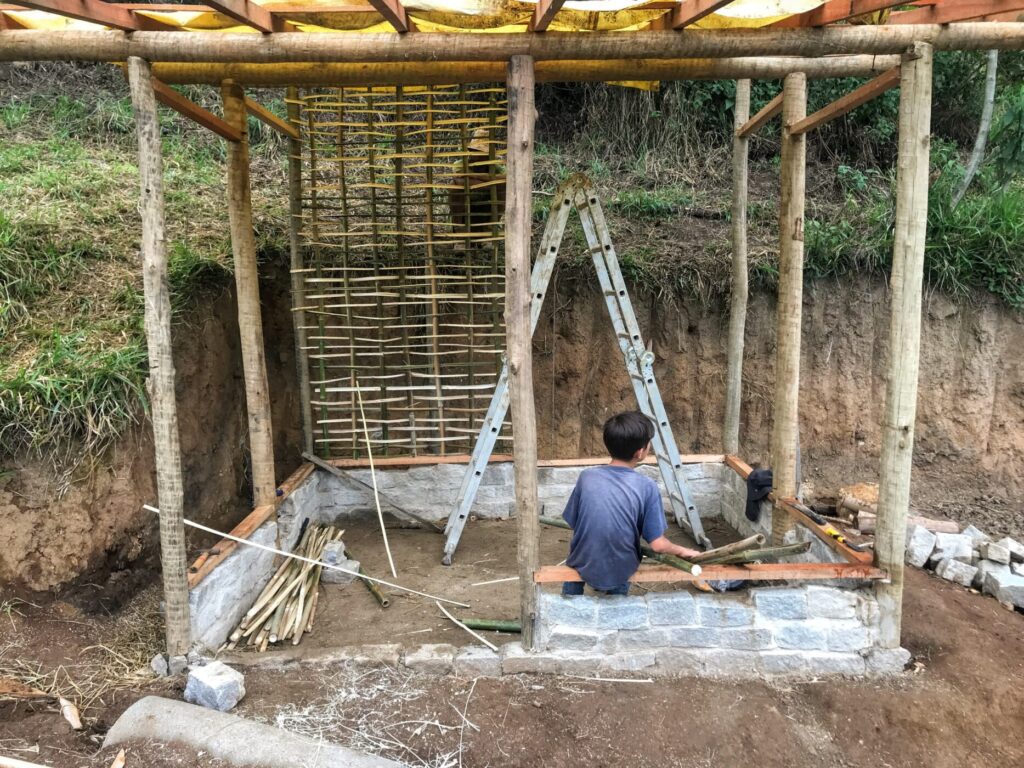
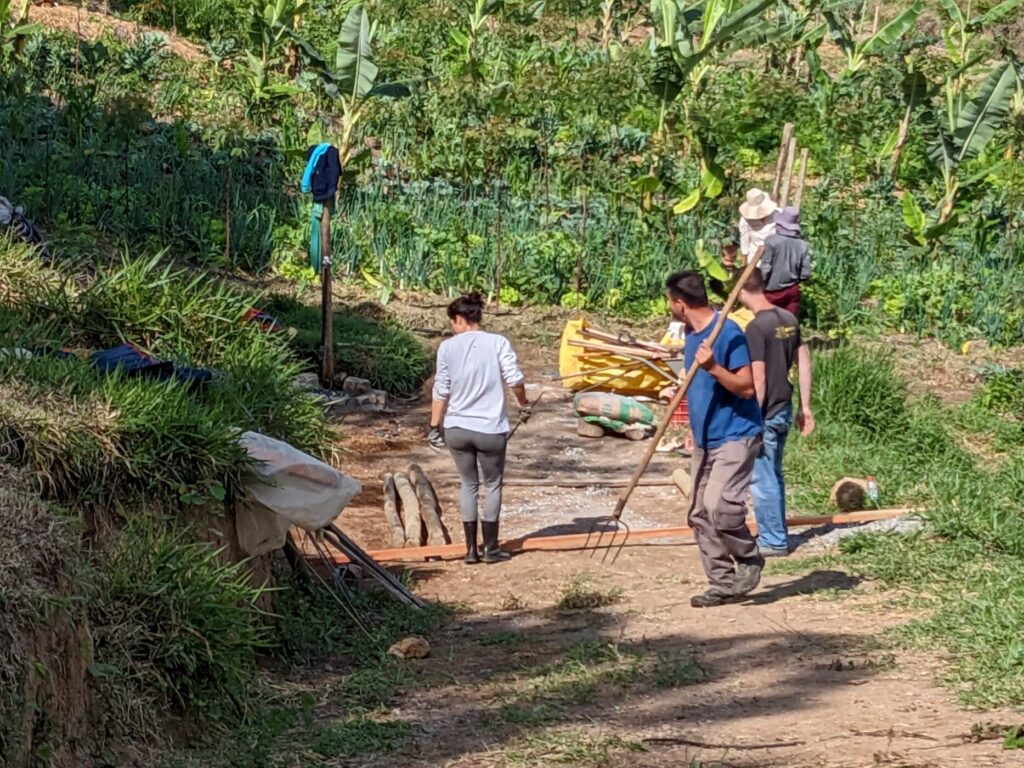
My usual task involves building this bio-constructed toolshed. When finished, the shed should save some trips up the mountain for those working in the lower fields.Volunteers working in the fields and on the bio-constructed shed.One of the views we can feast our eyes on whenever we look up from our work.
One of the main projects of Eco Caminhos is Agroforestry. And the first step is already being carried out by our team under the guidance of our forest engineer, Bruno Nirello. It all starts with the planting of Mexican Sunflower (Tithonia diversifolia), the idea is to use this plant’s nutrients and properties to improve soil quality and get it ready for the wide variety of plants and trees that will follow.
“After pruning and being applied to gardens and soil, the Mexican Sunflower helps improving the levels of nitrogen, potassium, calcium and magnesium”, explained Bruno, who also stated the reasons to use this plant now, during winter. “Since it is a summer plant, it will not develop much now, but we are already planting so that they will be ready to be used when their season arrives”.
Another interesting advantage of the Mexican Sunflower for our project was explained by our agronomist, Anastacia Almeida. “Although it is an exotic species, native to Central America, it serves the major purpose of bringing the necessary biomass to start an Agroforestry project. Plus, due to the fact that it has plenty of flowers, it attracts many pollinators, such as bees, which have a positive impact in all levels of the ecosystem, and this increases biodiversity as a whole and also gives more autonomy to our Agroforestry.”
The first step to use the Mexican Sunflower in the Eco Caminho’s Agroforestry was done throughout the last couple of weeks when we started collecting several truckloads of this plant. Since then the team has planted hundreds of seedlings by staches, and part of the collected Mexican Sunflowers were grinded and used to fertilize our local vegetable garden and to prepare the soil that will receive the next stages of the project.
After planting of the Mexican Sunflowers, Bruno already had in mind what will be the next steps for preparing and naturally improving the soil of our Agroforestry project. “Because of winter, we will plant lupine (Lupinus) and black oats (Avena strigosa Schreb). Lupine has the same function as the Mexican Sunflower, but develops better in winter. Black oat, which is also a winter plant, is a forage grass that fixes a lot of phosphorus in the soil”.
Check out the video that illustrates the process of harvesting and milling the Mexican Sunflowers:
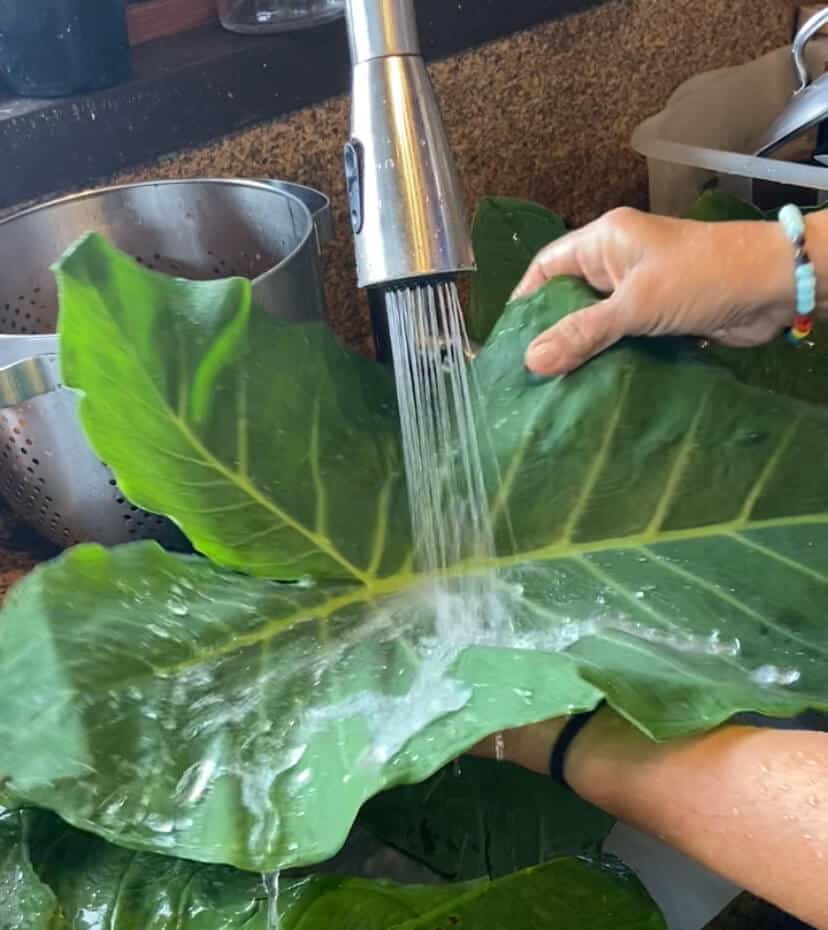
 leafy green native to South America, is a key player here at Eco Caminhos farm due to its health benefits and usefulness within agroforestry. This plant can be found in kitchens across Brazil, Africa, and Trinidad and Tobago. In this article, we will explore the wonders of taioba, from its ecological role to its culinary applications.