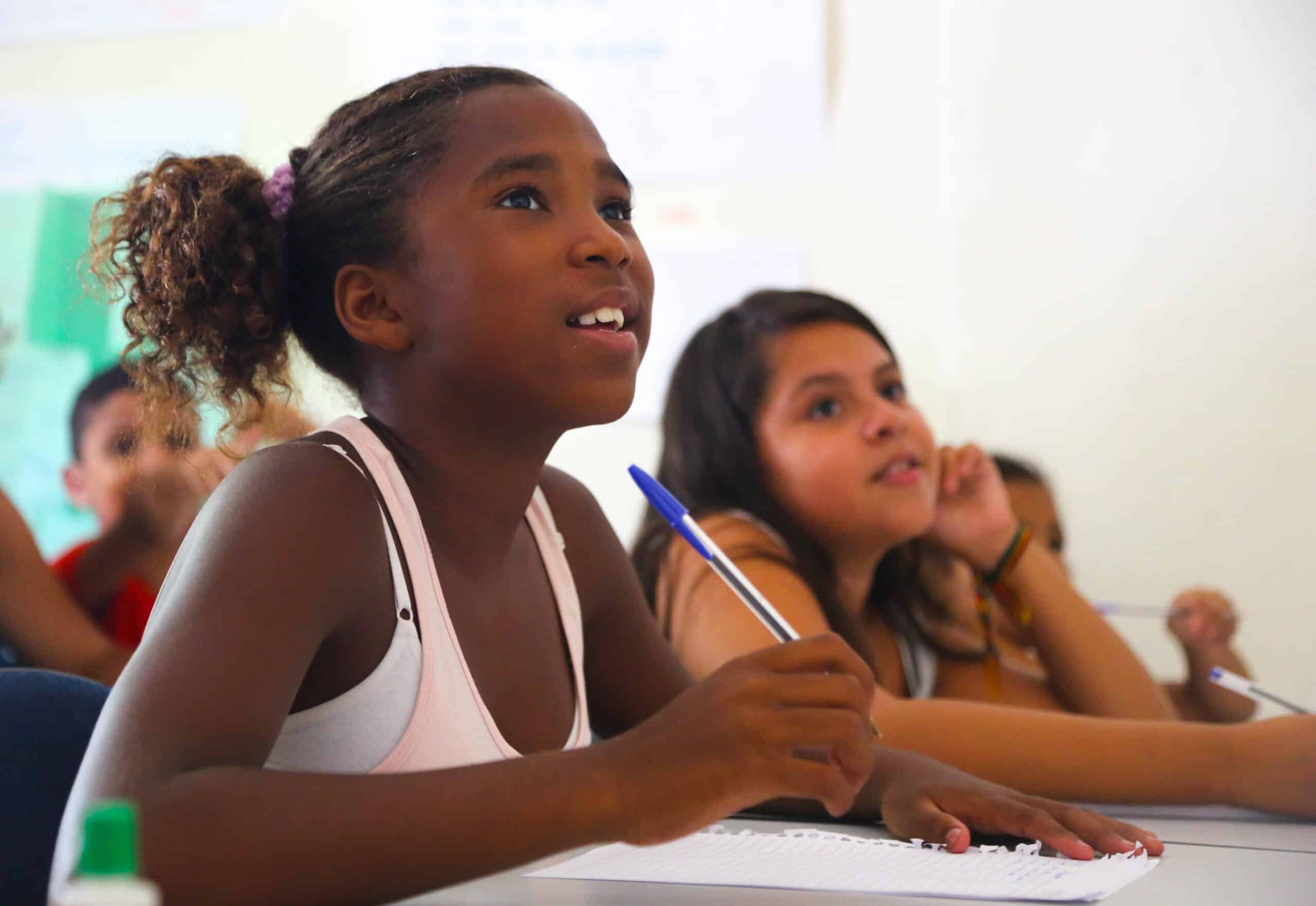
In today’s increasingly self-centered and fragmented world, regenerative organizations offer a powerful response to the climate crisis, rural youth exodus, and growing social inequality. Despite macroeconomic improvements, many young adults in urban areas still face high unemployment and informal jobs, with few real opportunities for personal and professional growth.
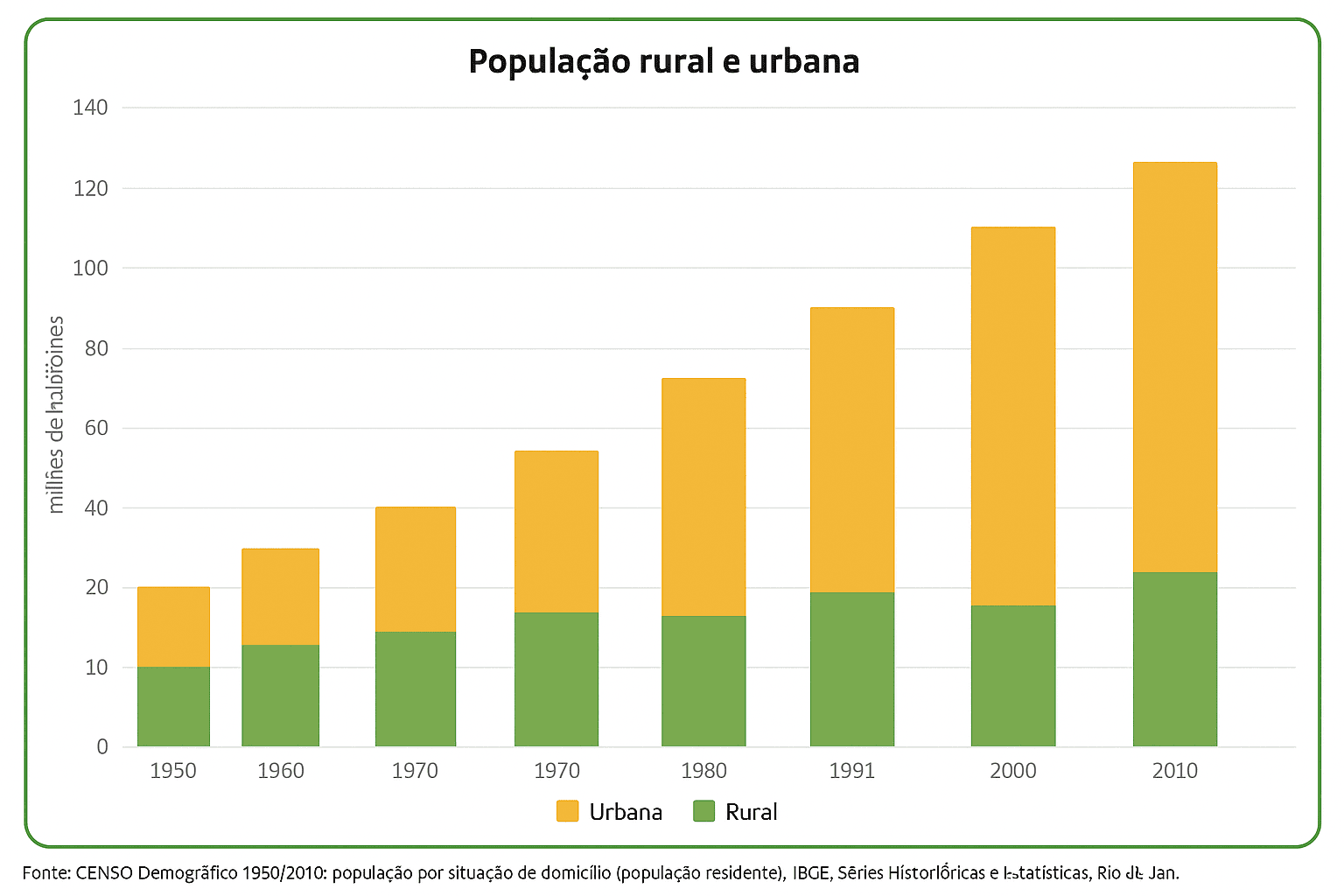
According to the Conexão Escola portal, Brazil’s urbanization process is closely tied to population density and has led to a significant rural exodus. From 2010 to 2022, Brazil’s rural population declined from 15.6% to 12.6%, while the urban population rose from 84.4% to 87.4%. This trend illustrates not only a territorial shift, but also the forced displacement of rural communities due to lack of opportunities, highlighting the urgent need to strengthen regenerative organizations in rural areas.
This is where Eco Caminhos and the Ecolibrium Association step in. Based in Nova Friburgo, Brazil, they are pioneering a model that harmoniously integrates ecological, social, and commercial dimensions—proving that it is possible to regenerate the land while also empowering people and building financially sustainable systems.
Over the passed 20 years a group of organization have colaborated in social activities mainly focussed on underprivileged youth in Brazil. It all started with the Comunidade Rural Casa do Caminho orphanage in Brazil where Bart Bijen became the managing director. In 2006 the Stichting Avante Educação Brasil was founded in the Netherlands with the objective to support the children of the orphanage and other underpriviledged youth in Brazil.
Then in 2009 the Caminhos Language Centre in Rio de Janeiro was founded. A Portuguese Language School for foreigners with 2 goals. Generate funding for underprivileged children and teens from the orphanage and also the favelas in Rio de Janeiro. The school is owned by Bart and Jascha. Jascha is the managing director.
In the language school surged “Mais Caminhos” which was the social arm of the school which grew together with the school and is now an established organization.
And in 2015 Eco Caminhos in Nova Friburgo, Brasil was founded with the purposes to impact both the environment and underprivileged youth.
As the social programs have grown in 2023 we have now founded a Brazilian Foundation called “Ecolibrium” with the purpose to raise funds in Brazil and abroad to increase the social and environmental impact in the region.
The realized work in 2022
The support of educational and social projects in Brazil by the Avante Educação Brasil Foundation runs through the programs: 1. Mais Caminhos 2. Eco Caminhos Apprenticeship (school) 3. Support for Davi and family
Mais Caminhos
In the program Mais Caminhos is aimed at providing education and support for children from the favelas Cantagalo and Pavuna in Rio de Janeiro. The program functions at the Caminhos Language Center in Rio de Janeiro. The manager Marie Dupuy runs a team of volunteers. For a reports of the activities and achievement you can check the mais caminhos website.
Eco Caminhos Apprenticeship
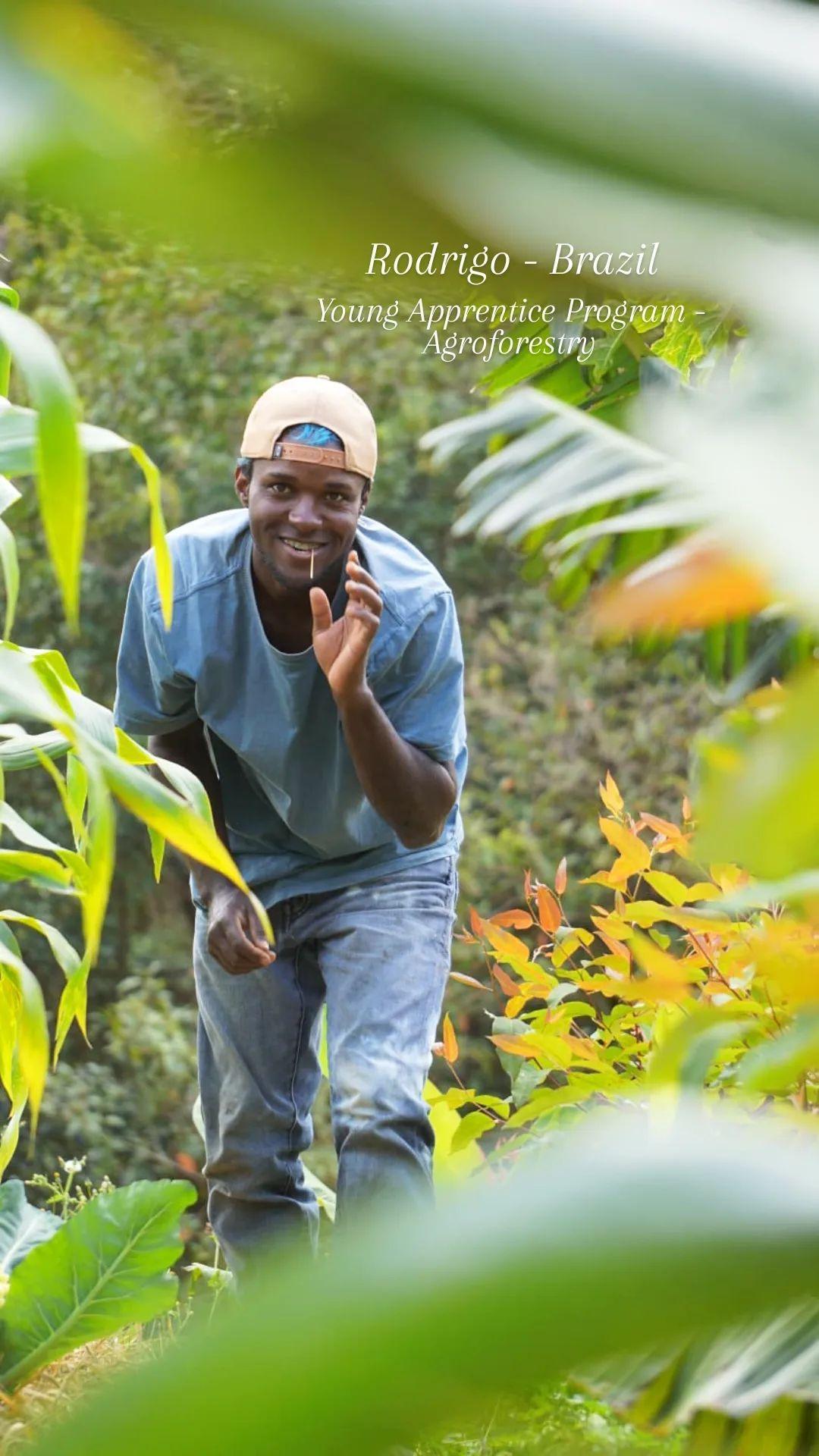
The Avante Educação foundation also supports the apprenticeship program of Eco Caminhos. An Eco farm near Nova Friburgo in the state of Rio de Janeiro. The Eco Farm also receives underprivileged young adults with little perspective. youngsters live at the farm for one or two years receiving accommodation, food and a stipend. The young adults can specialize in bio-construction or agroforestry.
They also learn how to behave on the labour market and how to take care of themselves: cleaning, cooking and learning how to handle money. In 2022, there were 4 apprentices. Of these, three have successfully completed the programme. One of them is now contracted by Eco Caminhos as an employee, two have left after going abroad after meeting a friend within Eco Caminhos. In 2023, two new apprentices have started and two more are starting in May,
Davi and Family
Support to Davi and family The Avante Educação Brasil Foundation has been supporting Davi Porfirio and his siblings for many years. The family spent an important part of their childhood in the Casa do Caminhos orphanage near Rio de Janeiro. Davi then spent an exchange year in Genhout Beek with the Pirson family . He then went to study and works at the Caminhos Language Centre where he is responsible for touristic activities for the students. Two brothers and a sister are now adults and stand on their own two feet. There is another brother Tiago who is forteen years old and is currently in school. In the video below Davi explains why the support needs to continue for a few more years.
Davi will now move to France in 2023 where his girlfriend lives. Luciana, Davi’s sister, will continue to care for Tiago. Luciana doesn’t make enough money to support Tiago. Davi will have to set up his life in Europe first and get a job in France . Until then, we will continue to provide financial support. We kindly ask the donors to continue to support for at least another four years until Tiago is an adult. Davi is supported by about 40 sponsors who pay a monthly amount.
AEB Foundation
The AEB Foundation does fundraising for all the projects described above and does annual fundraisers for specific projects. The board consists of Jan Bijen (chairman), Jascha Lewkowitz (secretary treasurer) and Maarten Vonhögen (secretary).
A family shares their experiences staying in Eco Caminhos’ newly-built Eco Lodge
By Liuan Huska, eco-experience volunteer
(Read more about the Huska family’s year-long travels through South America on their blog, Slow Camino.)
“If you want to be nice to the environment, go ahead and build a shack in the woods, dance half-naked around the fire, and cut yourself off from the system.” This is the essence of what my husband, Matt, told me in one of our many discussions around my environmental ideals and modern reality.
In my ideal world, I want to have a positive rather than negative impact on the earth. But the reality is that we live in a global society structured around high energy consumption, disrespect for nature, and depletion of natural resources. It’s hard, on your own, to escape living in this system.
Given this reality, the idea of sustainable living has often been tied to the idea of sacrifice. To be kind to the planet, we think, we must sacrifice our conveniences, our meat, our flights, and our creaturely comforts like a warm house in the winter. We assume that reducing our carbon and ecological footprint means we have to go backwards along the trajectory of human progress. We have to regress to a more primitive, less comfortable, way of life.
I still think we need to dramatically shift our understanding of a “good life” toward less materialism and consumption. But living at the Eco Lodge here at Eco Caminhos has made me question the equation of MORE SUSTAINABLE = LESS COMFORT.
What is Eco Caminhos and the Eco Lodge?
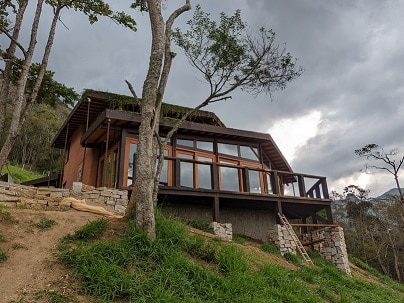
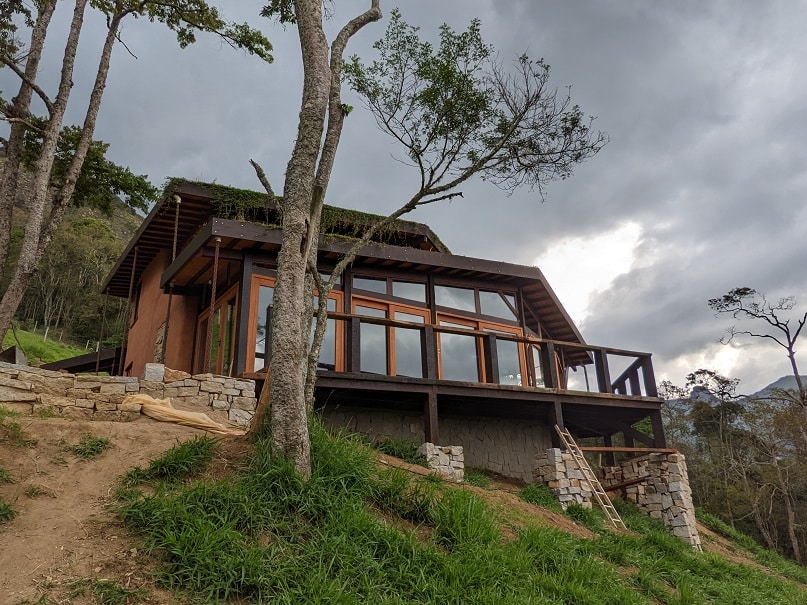
The Eco Lodge at Eco Caminhos.
Eco Caminhos is a permaculture farm in the mountains north of Rio de Janeiro, within the Atlantic Forest ecosystem. Their focus is on bioconstruction (using sustainable, local, and natural materials to build) and agroforestry (integrating trees and mimicking forest systems in crop growing). They also welcome a range of people to participate and learn, including local Brazilian apprentices, short- and long-term international volunteers, and families like us.
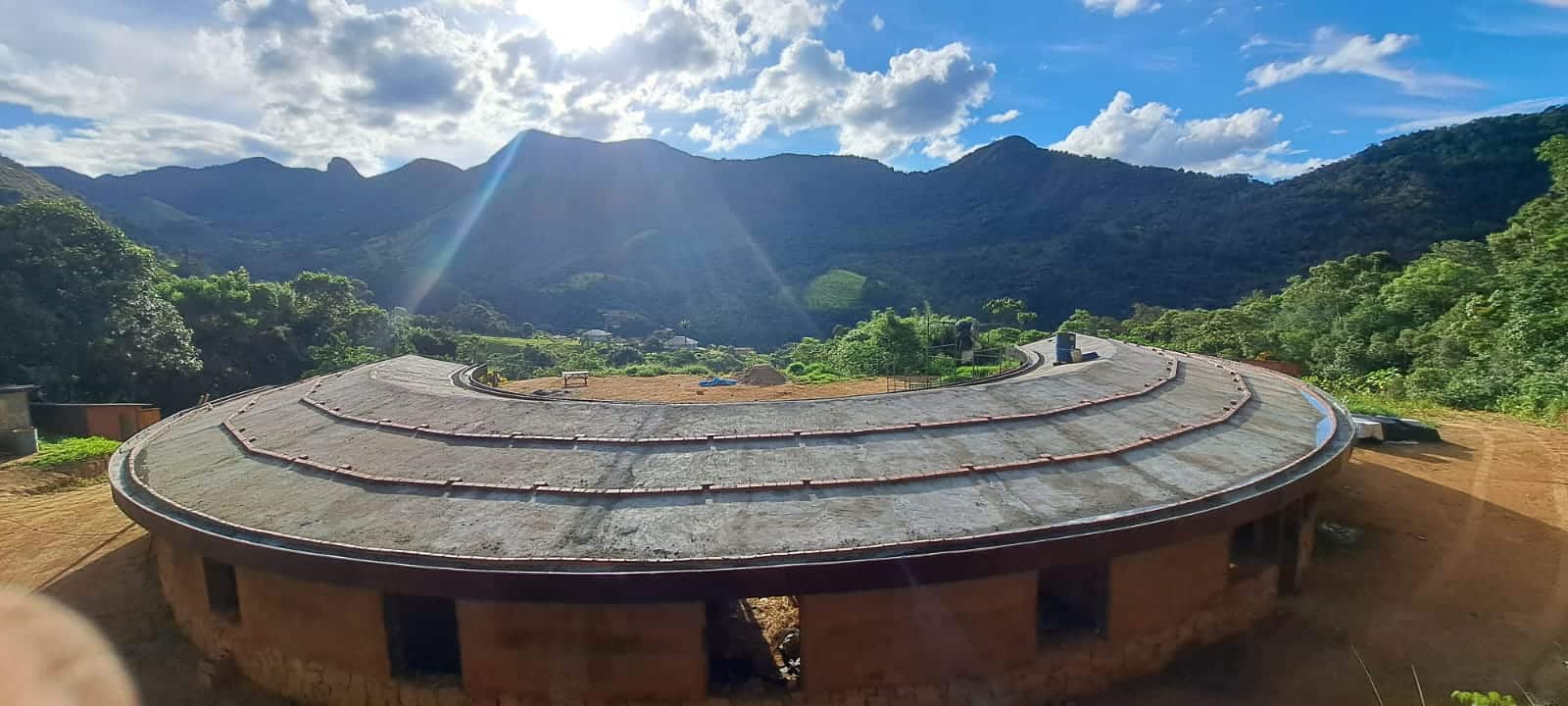
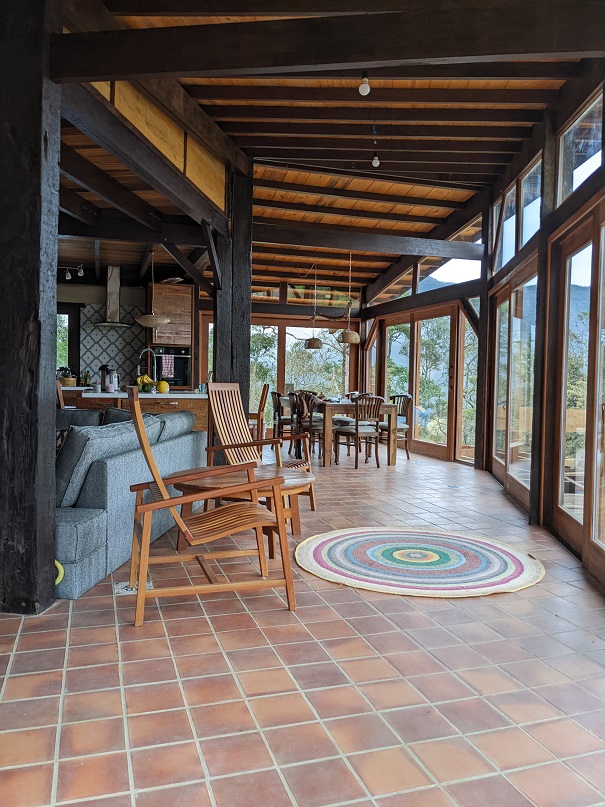
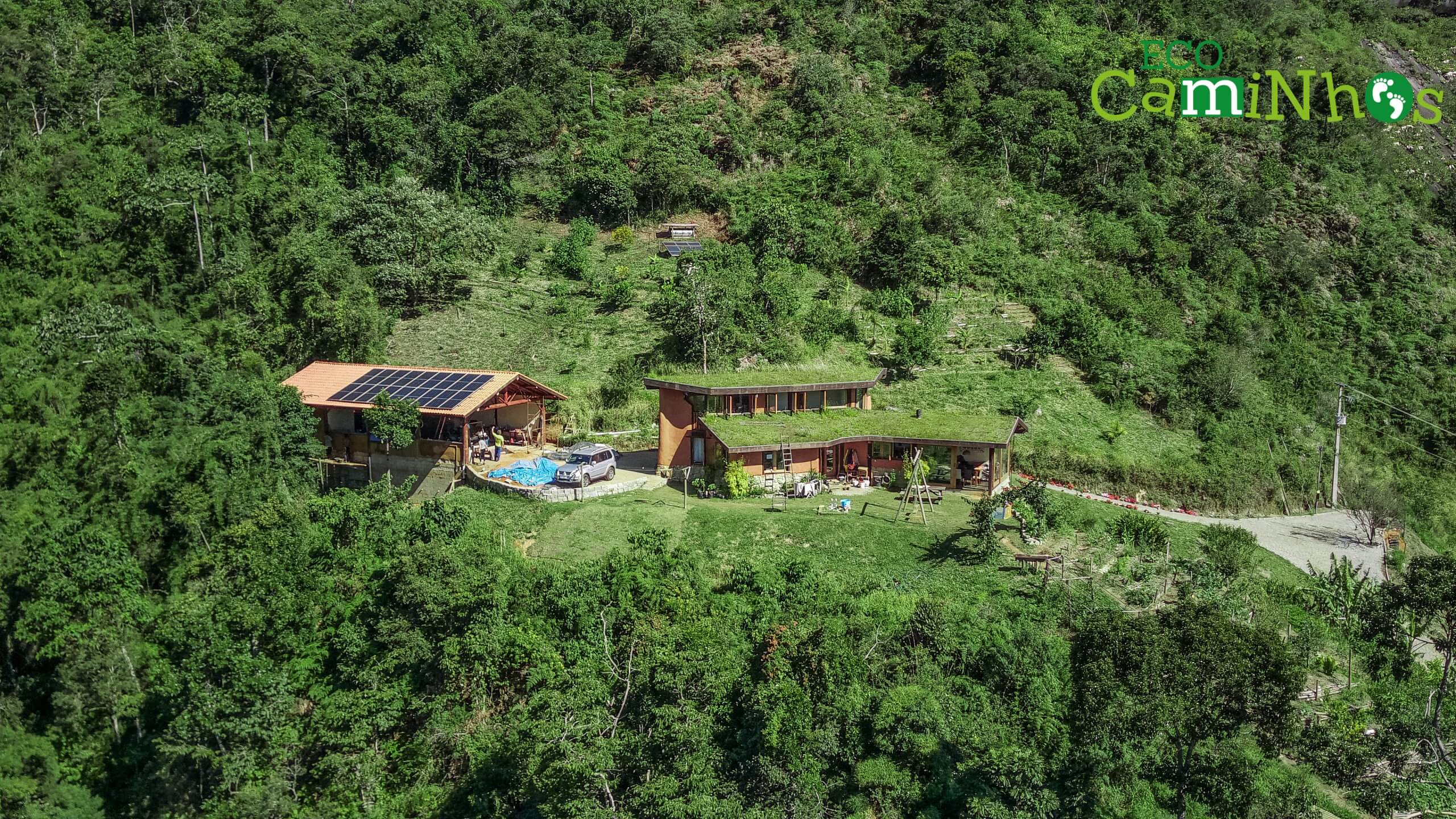
The Eco Lodge is the third major bioconstructed building that Bart Bijen (the founder of Eco Caminhos) and his team have taken on. When you enter the gates of the farm, located on outskirts of Nova Friburgo city, you can see the Eco Lodge perched at the top of a steep, zigzagging road into the property. It is a beautiful structure – rustic wooden outlines, stone base, earth-toned walls, vines from the green roof hanging down, and an expansive glass-lined living area opening out to a recycled-wood deck that takes in the sweep of the mountains and the Cardinot valley.
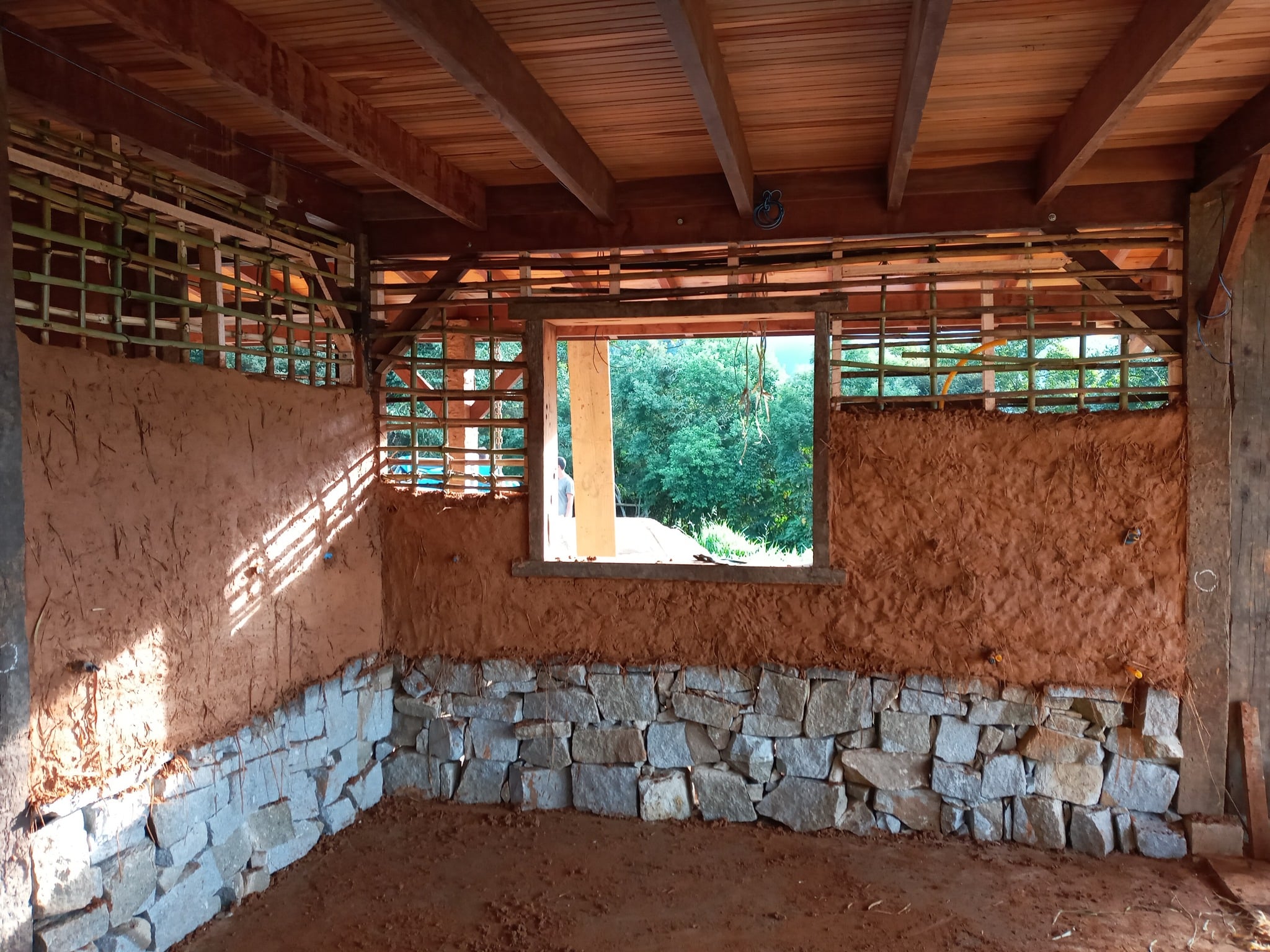
The building in-progress. You can see the natural stone, cob, and wood.
Since we started traveling South America three months ago, the Eco Lodge is by far the most luxurious accommodation we’ve stayed in. It is also, amazingly, the most sustainable. The building is made almost entirely of sustainable materials: locally sourced rocks, recycled wood, and cob walls consisting of a mixture of clay, sand, grass, and manure (almost all found on the property). There were some elements that had to be obtained from farther away, for example, hardwood beams (which are certified as not coming from the Amazon rainforest), various fixtures, drywall for the upstairs room partitions, and wood finishes.
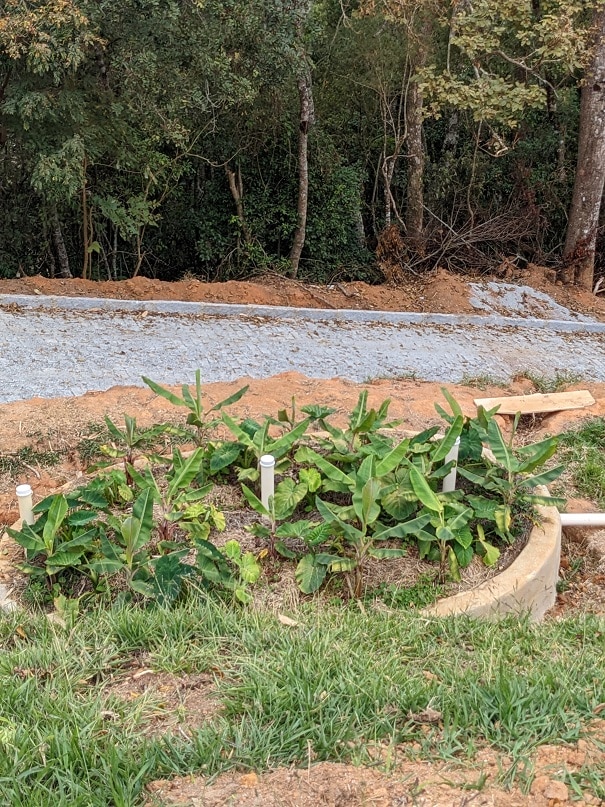
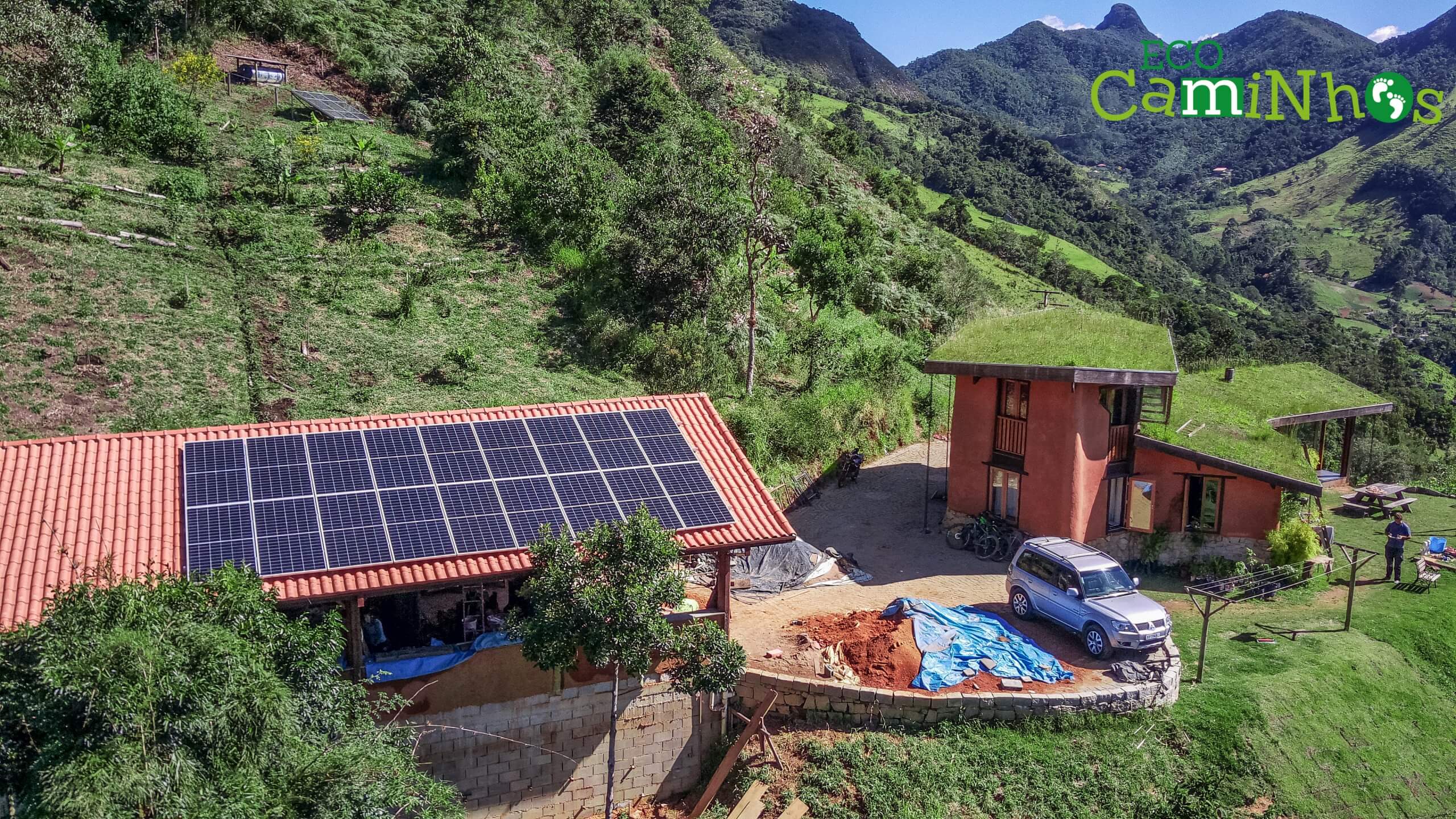
Connected to the farm’s solar net zero energy system, all the electricity we use in the Eco Lodge is renewable and carbon-free. The induction stove is electric and the hot water is powered by a solar boiler, so the building uses no natural gas. Our water supply is filtered after coming from higher-elevation mountain springs, and our waste water goes into a black-water and grey-water banana filter system directly below the house.
The wastewater system uses banana plants for filtering.
How does it feel to stay in the Eco Lodge?
Warmer
We stayed in a condo not far from Eco Caminhos for the first month of our time in Brazil, during July and August. Though this was an upper-class neighborhood, the home was built in typical Brazilian style—concrete walls, tile roof, and drafty. (Concrete, though cheap and convenient, has a huge carbon footprint.) Winters in this area are mild by Midwestern US standards, with temperatures dipping into the 40s Fahrenheit, or about 5 degrees Celsius. But without indoor heating or insulation, this translates to considerable discomfort. On some of the coldest days we wrapped ourselves in blankets, put on dance music, and did everything we could to keep warm.
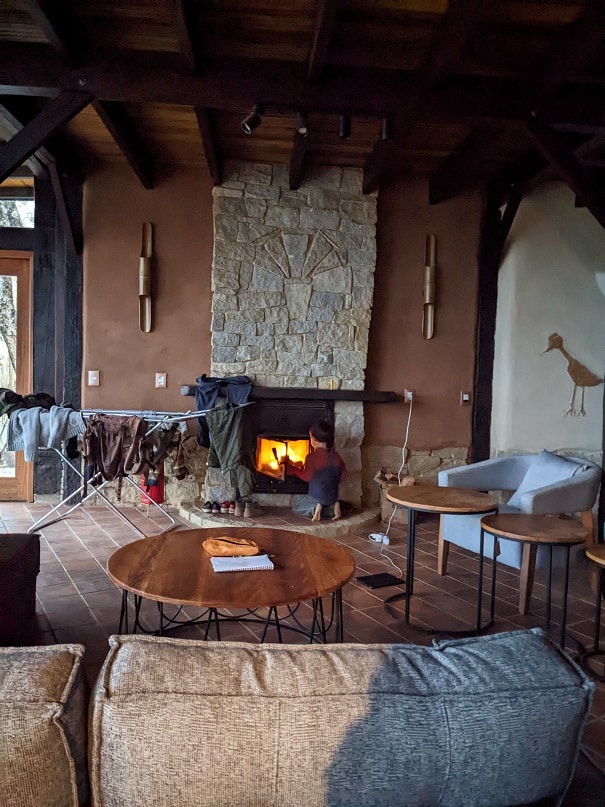
The Eco Lodge, with its thick earthen walls, holds heat in the winter and keeps cool in the summer. Despite some rainy, chilly days here, we haven’t felt nearly as cold as we did in the other Brazilian houses we’ve stayed in. Our kids have also really enjoyed tending the wood-burning fireplace, which is equipped with a fan that distributes the heat throughout the house.
The fireplace keeps the Eco Lodge nice and warm, and also helps dry the clothes faster!
As the world adjusts to more extreme weather, we can take inspiration from houses like these. The Eco Lodge is built with attention to the local microclimate, such as the position of the sun, the shadows of the mountains, how the water flows downhill, and wind patterns. Taking cues from nature, the goal is to work with, rather than against, the elements. By building smartly and consciously, we can preserve human comfort without further damaging the ecosystems that support us.
Small adjustments to rely on renewable energy
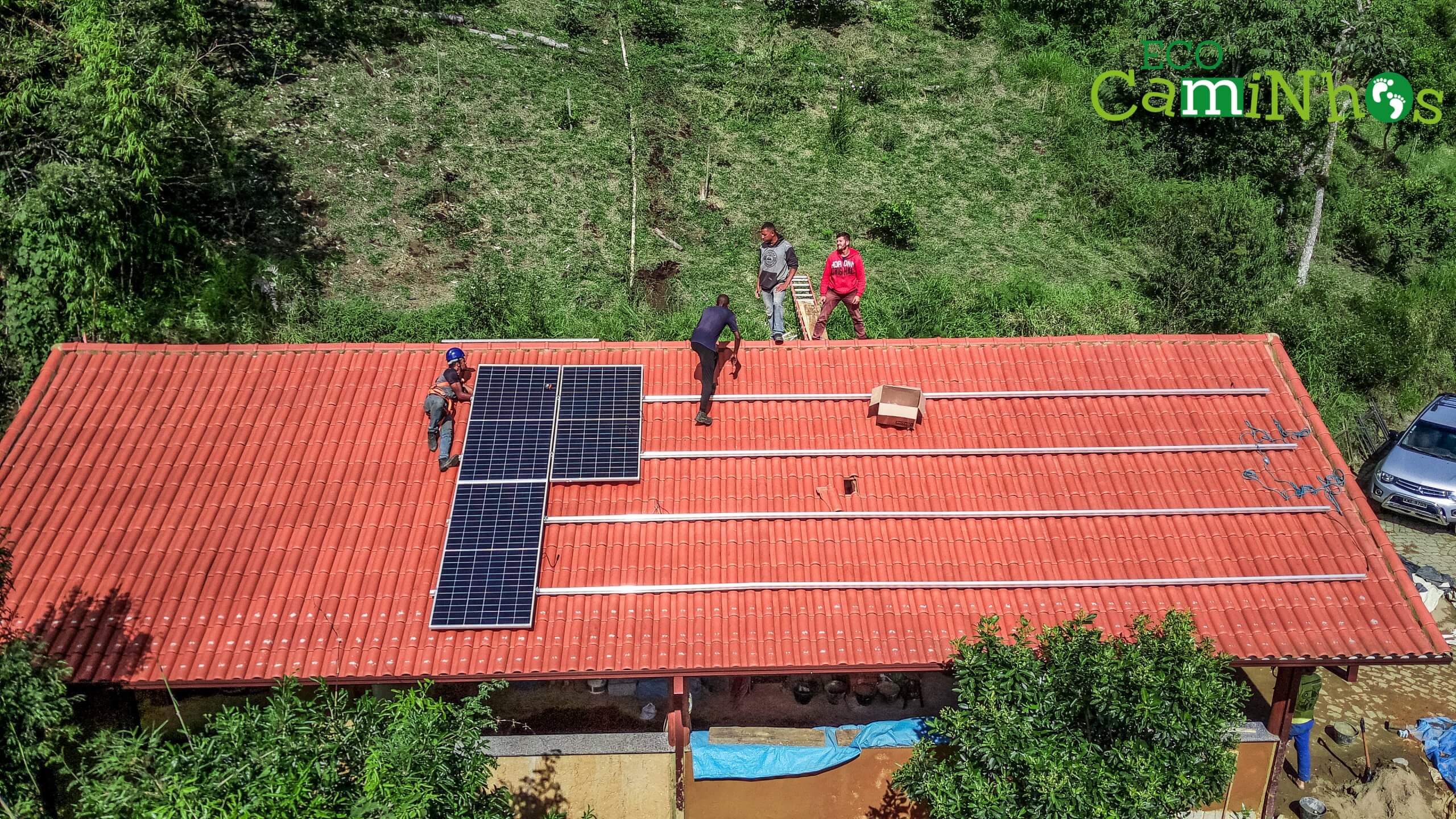
Solar energy is just that—coming from the sun. The farm produces solar energy through 16 panels installed on the roof of an all-purpose pavilion and uses solar boilers for heating water. But on days when it’s not sunny, these panels are not producing enough for everyday use. The available battery storage technology is still too expensive and ineffective to warrant the investment. While the goal is to become totally energy-independent, for now the farm is connected to the larger electricity grid. It puts solar energy into the grid when there is excess and relies on the grid when more is needed. This amounts to a net-zero energy balance.
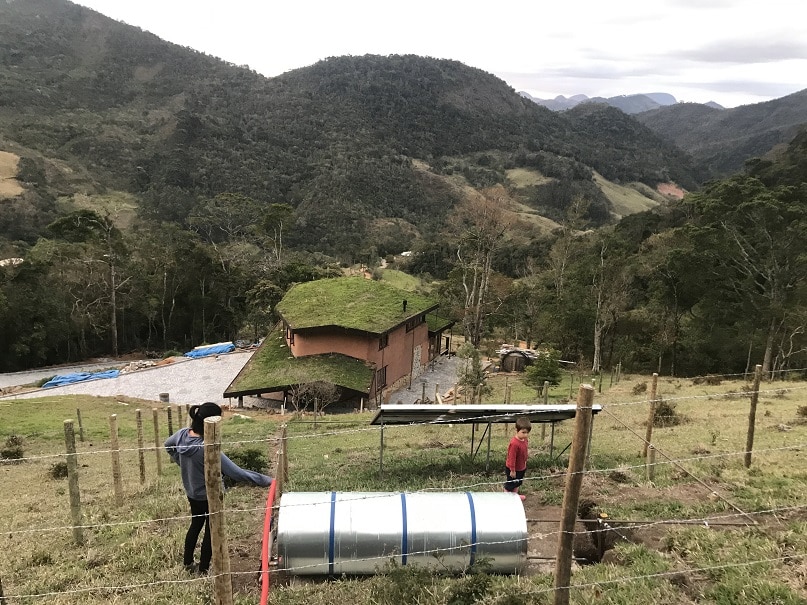
We take a visit to the solar water boiler above the house. It is an amazing contraption!
For the solar water boiler, most of the time the hot water tank is not connected to the grid. There is often enough sun during the day to sufficiently heat the tank for warm showers. But if it’s a cloudy day and we want to shower, we have to remember to switch on the breaker for the water boiler to connect it to the grid and let it warm for a few hours. Otherwise, it’s a VERY refreshing cold shower. We’ve preferred to stay dirty on days when we forget.
This is an example of the kinds of small changes we will need to make as we shift our energy systems away from fossil fuels to wind and solar energy. Like the people of Uruguay, who are leading the way in an energy transition that doesn’t sacrifice human comfort, we might have to organize our more energy-intensive tasks around the periods when wind and sun are most abundant. For me, these small shifts are totally worth the benefits of not releasing more carbon into the atmosphere and further polluting the air we breathe.
Connected to the Earth
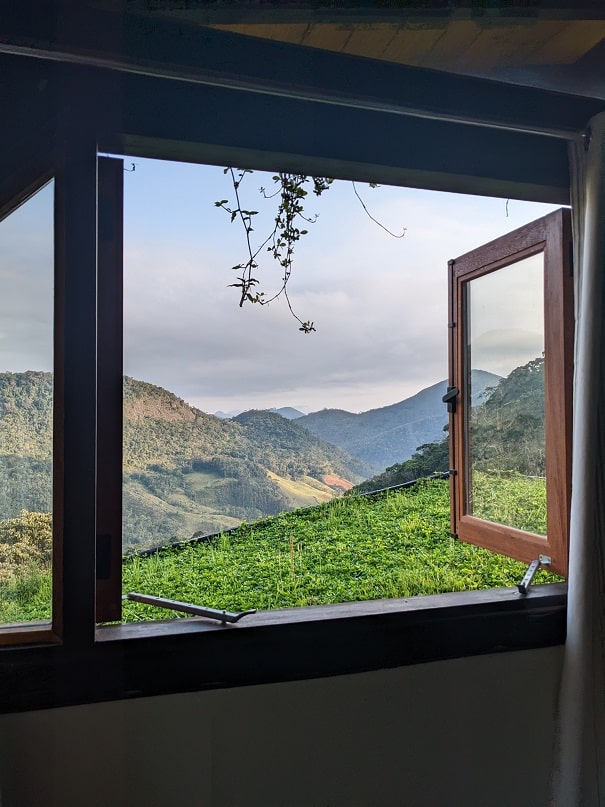
The morning view from an upstairs bedroom window.
We wake up at six in the morning to daylight breaking through the curtains and bird calls. I rub my eyes, put my feet on the acacia wood floor, and pull aside the curtains to see what views Mother Nature is gifting today. Sometimes it’s a lush world of drizzly mist, sometimes it’s bright sunshine and a breeze, sometimes it’s fluffy clouds that blanket the valley below. Often, I open the windows to look out over the green roof and take a couple minutes to breathe the crisp mountain air.
Our kids enjoyed playing right in front of the wall-to-wall windows. Amazing view!
After getting dressed for a day of work on the farm, I walk down the spiral staircase to see my kids playing in front of the wall-to-wall glass windows that open out to the terrace. I never get tired of this stunning view. My toes touch the cool tile and I shuffle over to the open-concept kitchen to eat breakfast.
After breakfast, we walk the farm road up to Colmeia, where the day’s farm activities begin. This is one of my favorite parts of the day. We step out right into the middle of the farm, not quite knowing what the day holds. Maybe it will be an encounter with a cow, a good conversation with other volunteers, a reflective time planting corn among the zucchini seedlings, or the satisfying manual labor of collecting cow manure or digging a trench to start a bioconstructed toolshed.
After a full day of work and learning, I often stop by the fields on the way home to pull a head of lettuce and some green onions to make a salad to go with dinner. Maybe we’ll have some roasted cauliflower from the fields as well, or lentils with farm-grown collard greens. It’s lovely to live so close to the food we’re eating and understand the love and respect that has gone into growing it.
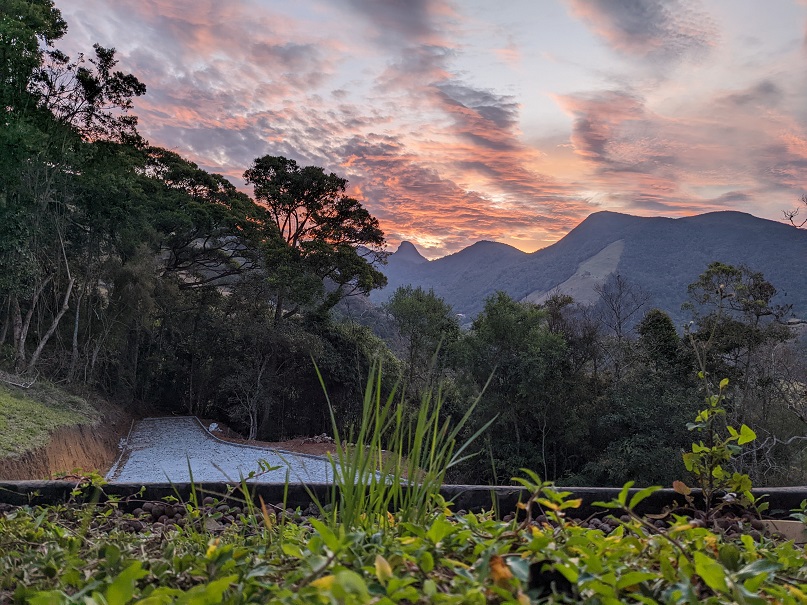
Sunset over Focinho do Porco Mountain, viewed from an Eco Lodge window.
As the sun sets, I look over the mountain ridges encircling the Eco Lodge. There’s Focinho do Porco (Pig’s Snout), my favorite, towering over the rest in the distance. It’s a special experience to stay in a place like this, sheltered by the wood, stone, and earth that has formed right in this area over decades and millennia. I know we won’t always be in such a beautiful place, but I hope to recreate this feeling of connection to the earth in whatever places we end up calling home.
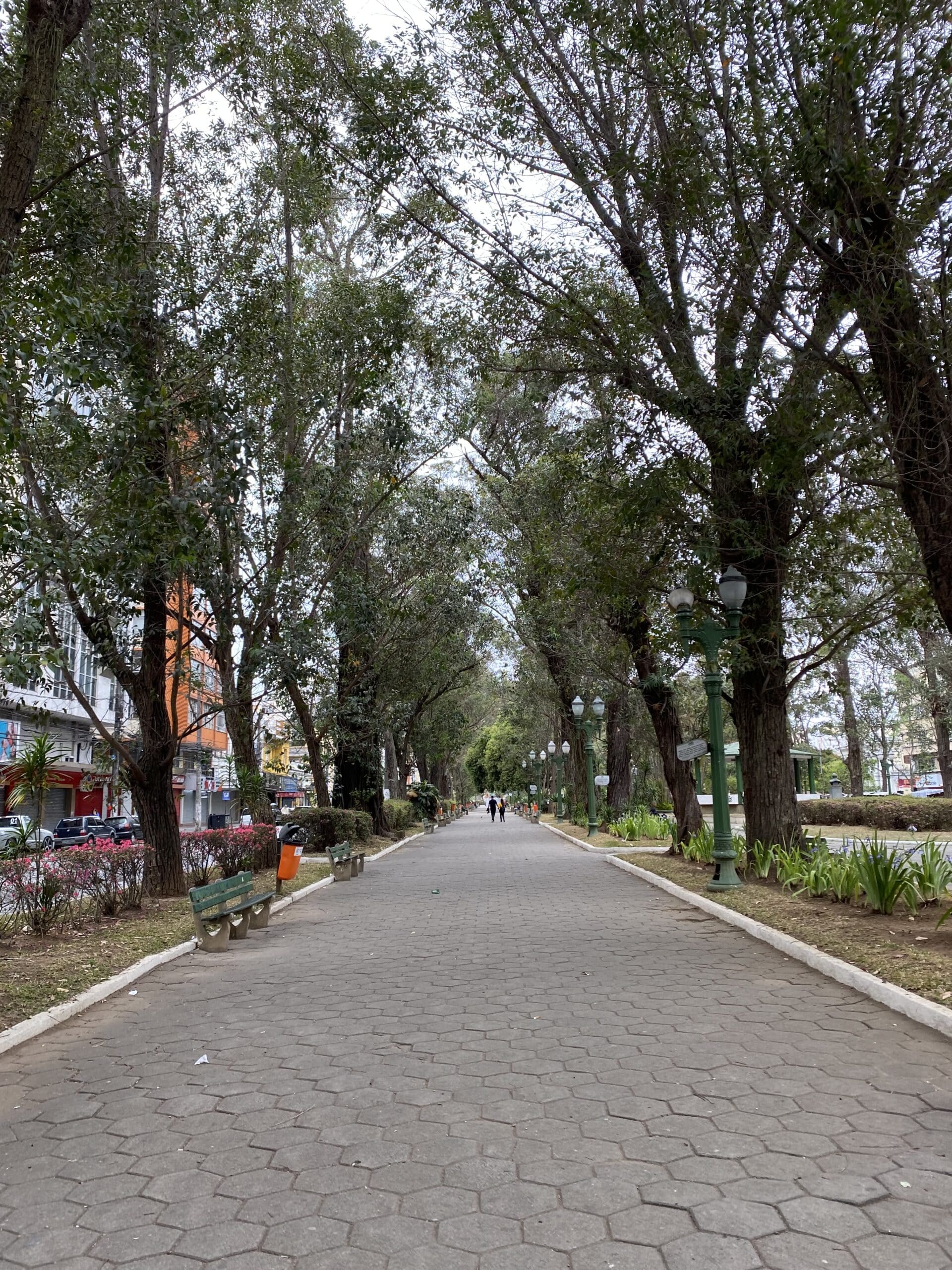
Nova Friburgo is a small city set in the Serra do Mar mountains of southeastern Brazil, located in Rio de Janeiro state. As a volunteer at Eco Caminhos, the city is easily accessible by bus. Here are some of our volunteers’ recommendations for this city.
HOW TO GET HERE
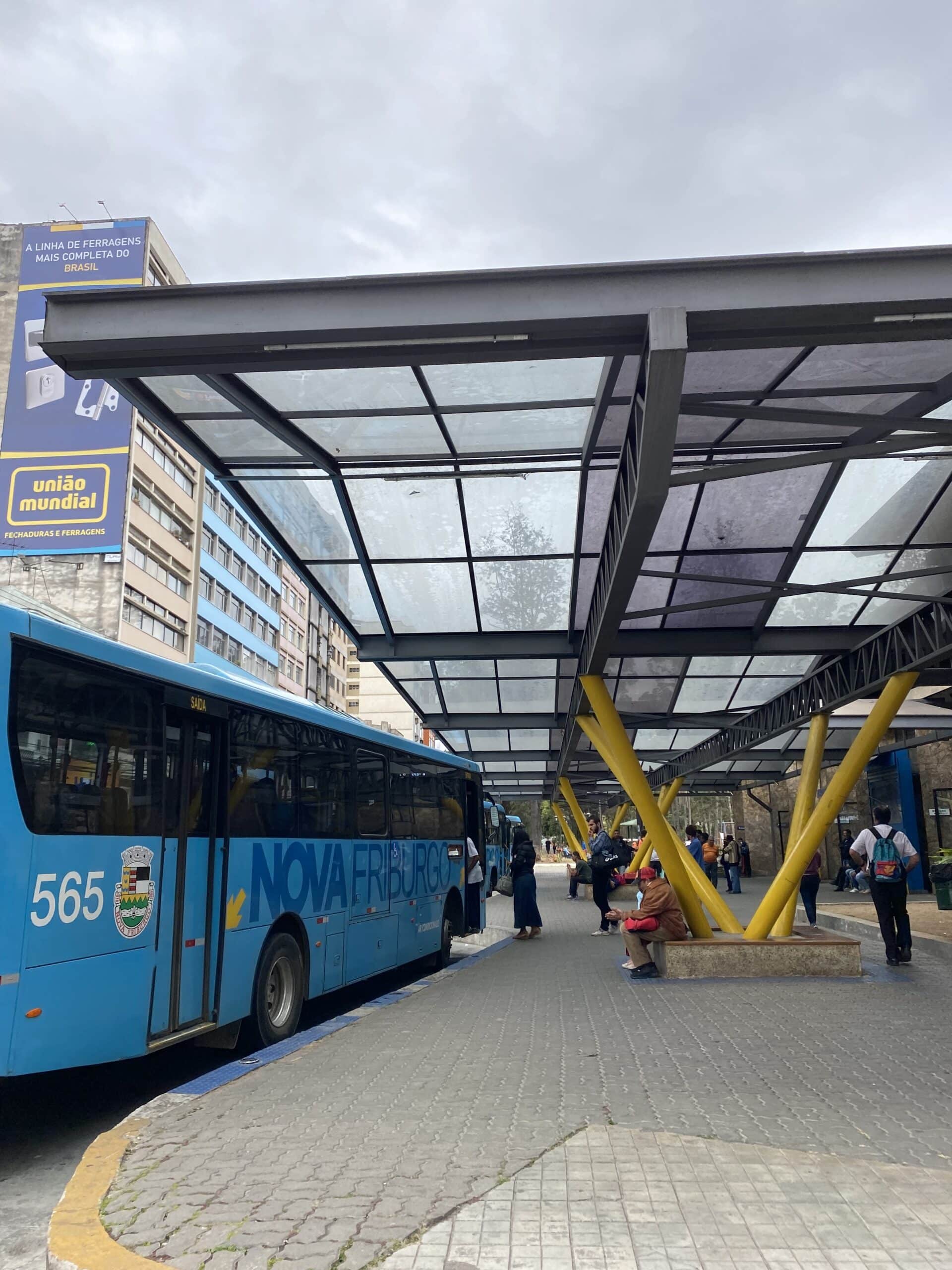
The city is a 40-minute bus ride away. Just a 5-minute walk away from the volunteer houses is a bus stop called “Ponto Final.” You can access the timetables here (look for the Cargo D’antas route). One-way bus fare is 4.20 reais, payable by cash.
WHAT TO EAT
Buffet
Lunch in Brazil is the most important part of the day. As the biggest meal, the common places for lunch are per-kilo restaurants that serve a wide variety of food options.
Restaurante e Pizzaria Excalibur – Offering both Brazilian and Portuguese cuisine, this buffet place can get packed during the afternoons and the weekends—and for good reason.
Restaurante Chantilly – A buffet restaurant offering a nice atmosphere, cordial service, and a rotating menu of tasty options.
Delicatessen Vinho Café e Cia – Don’t be fooled by the gourmet selection of wines and delicacies on the first floor; the upstairs area features a lunch buffet option with a view of the street.
Bakery
Leiteria Paissandu – A traditional-style Brazilian bakery with an extensive bread and pastel selection, along with extensive seating.
Padaria Suspiro – A no-frills, hole-in-the-wall bakery with a good array of fresh bread for good prices and some seating.
Cafes
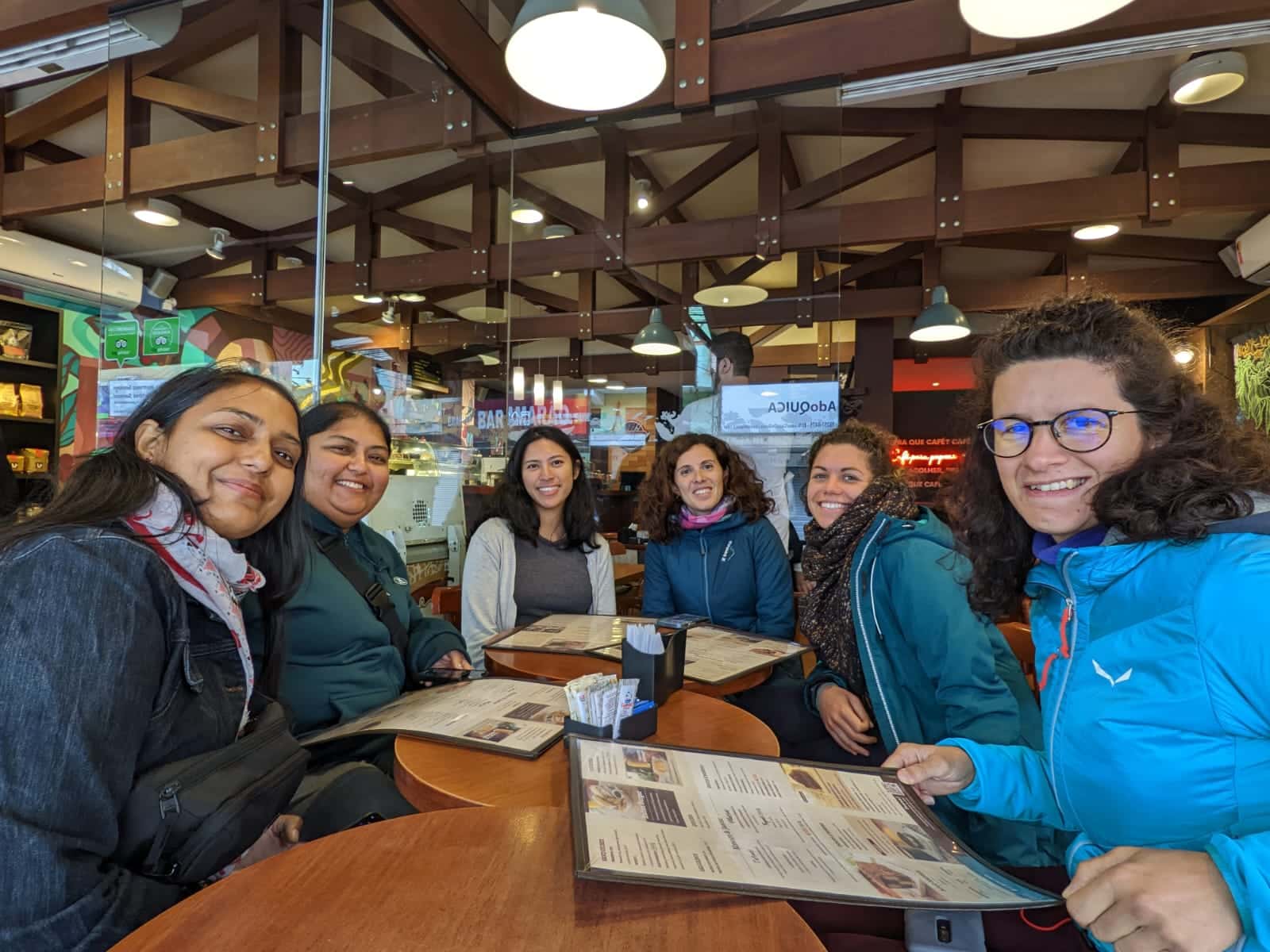
A girls’ trip to Grão Raro Café
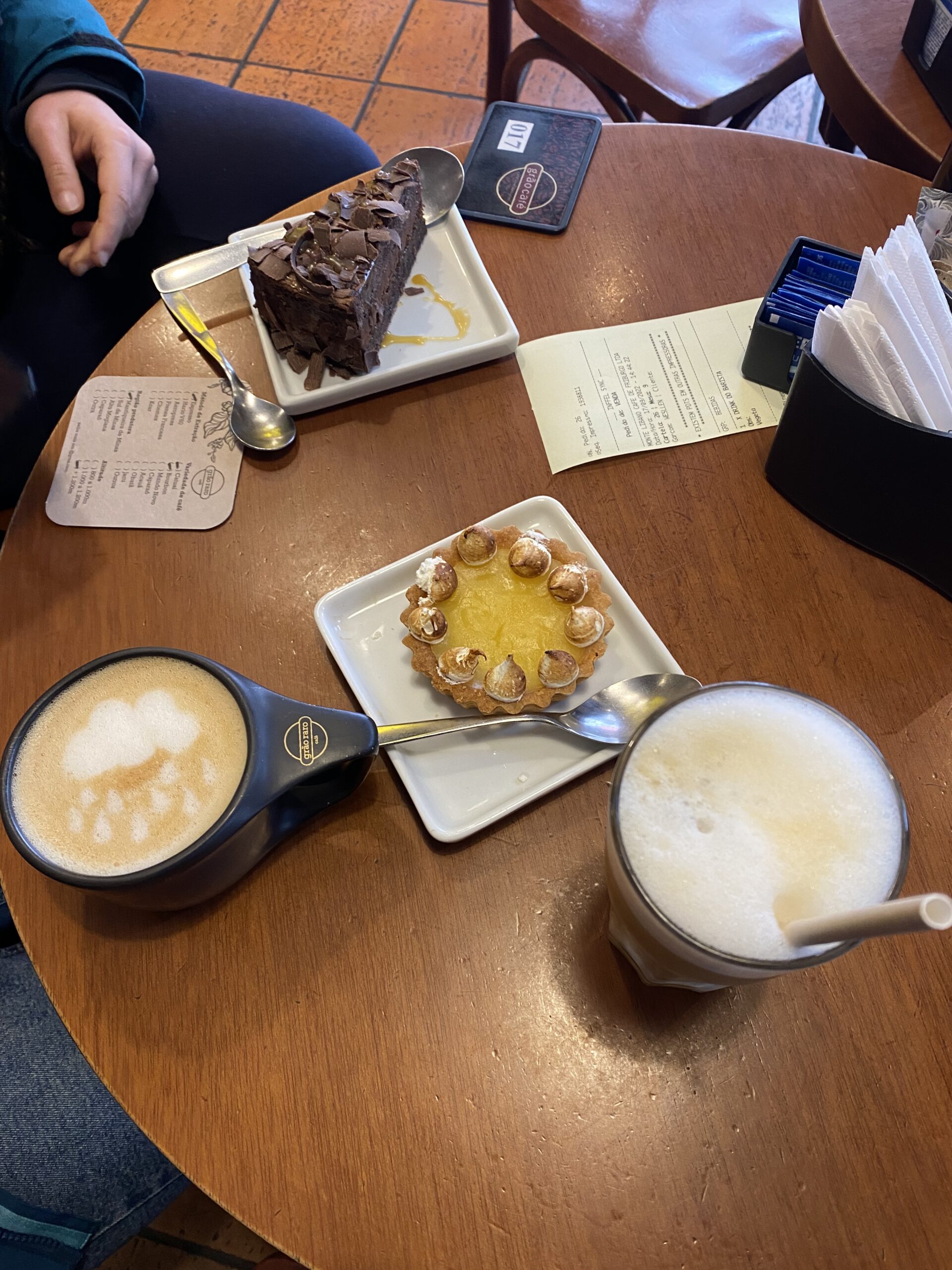
Grão Raro Café Friburgo – A chain restaurant featuring an extensive menu of drink options, including plant-based milk. There are also savory lunch options and sweet pastries if you’re feeling peckish. Need to get work done? There’s unlimited Wi-Fi and some charging outlets.
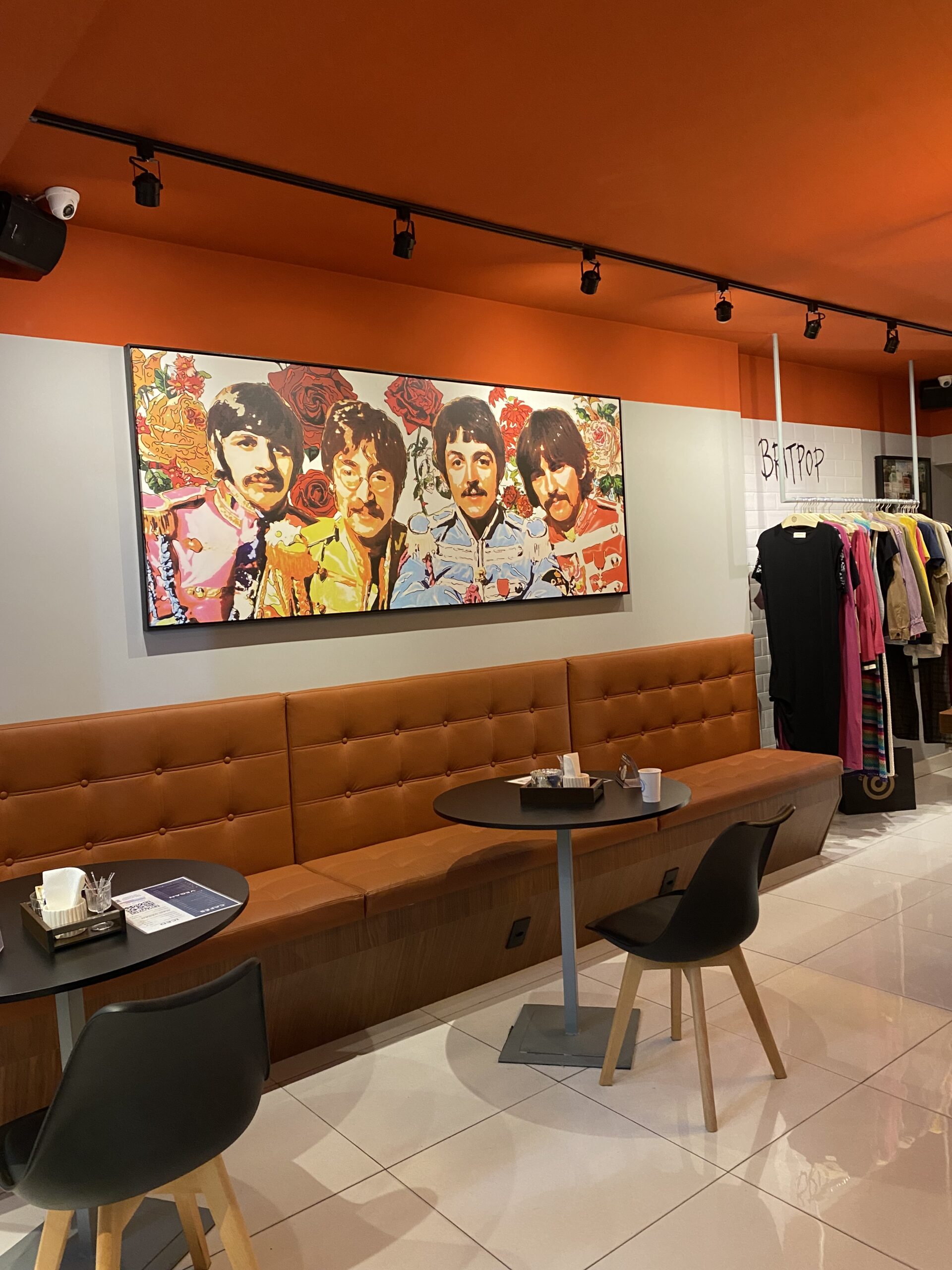
Popmix Café & Boutique Indie – This café features a cool rock ‘n’ roll 60s aesthetic—with vinyl records and funky clothing for sale, at booth. They also offer Wi-Fi, vegan drink options, and some alcoholic drinks. On occasion, they host music events.
Mais 1 Cafe – a small but modern café offering coffee and other caffeinated beverages with outdoor seating options. They also sell pastries including pão de queijo, doughnuts, and croissants. They also write your name down on the cup with a smiley face. 🙂
Café d´Art Bistrô – A pretty little expresso bar tucked away into a nice shopping street, featuring a rotating selection of traditional Brazilian cakes in the display case.
Dona Emilia Gourmet Bakery – Open in the wee hours of the morning and on the weekends, this establishment features two locations. The main site on Monte Libano street has a terrace out back that can serve as a good place to relax, right within the heart of the city center.
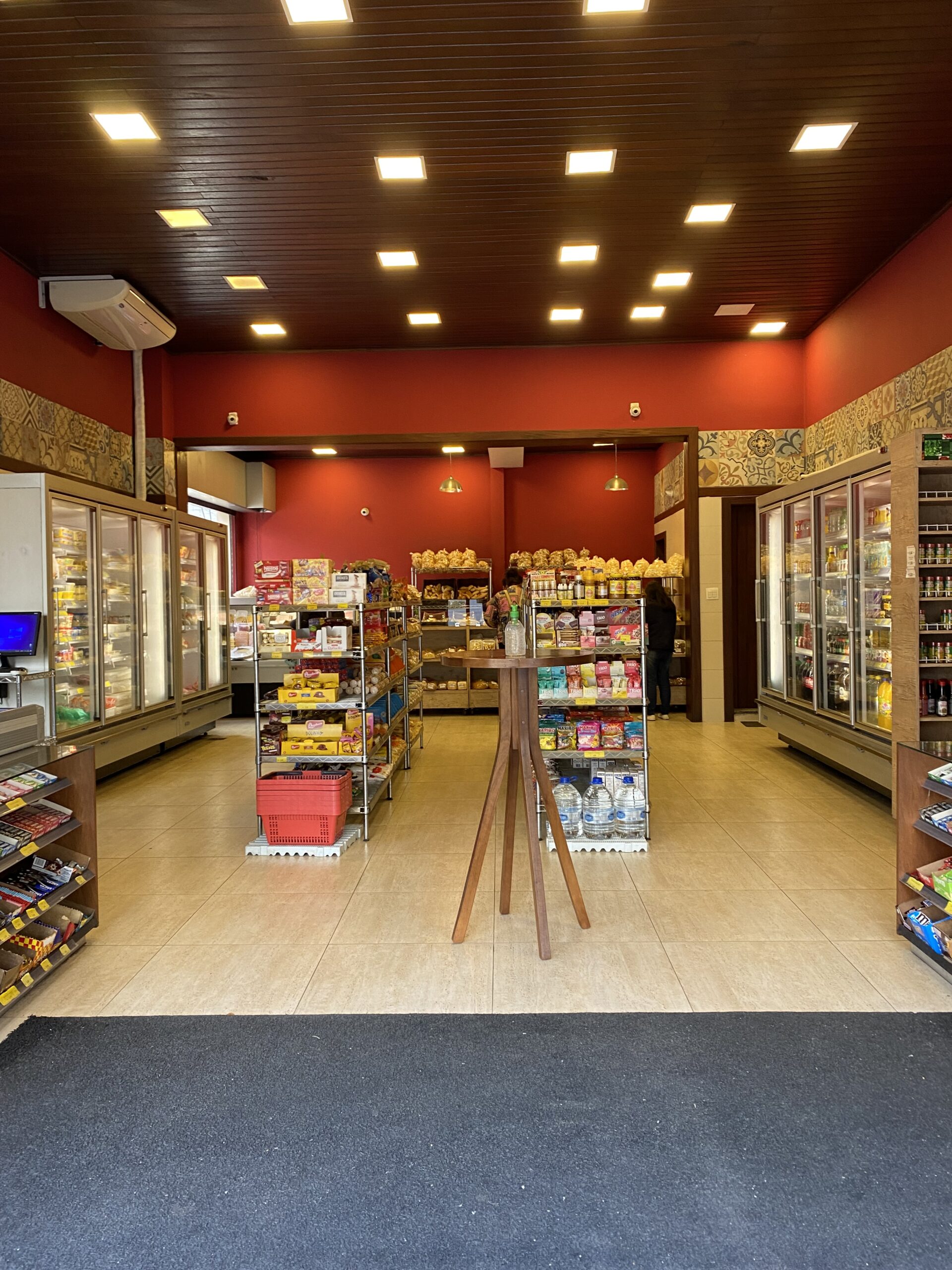
Superpão – A bakery, grocery store, restaurant, and café, all-in-one. They offer an extensive breakfast selection, and a good array of charging outlets. Note that they offer Wi-Fi but only up to 30 minutes per session, per device.
WHAT TO BUY
Clothing
Amil Esportes – A store offering name-brand sportswear like Nike, Under Armor, and Puma, along with hiking gear.
Casa Libaneza – The place to go to if you need hiking boots.
Household Supplies
Himalaia – Conveniently located near the city center, this store offers a decentselection of household items.
Loja Americana – This store offers most of what you may need, and some. They stock a decent selection of supplies, from clothing and bedding to snacks and shampoo.
STAYING HEALTHY
Fitness:
Academia Ribas Gym – A good-value gym located only a 6-minute walk away from the bus station (Estação Livre). There’s a good selection of exercise equipment along with Brazilian jiujtsu and spin classes. It’s 25,00 reais for a day pass and 120,000 reais for a month.
Fight Co – A fitness center with an open-air concept, excellent facilities, and class options in Muay Thai, Brazilian Jiu Jitsu, and Crossfit throughout the week.
Volunteer night
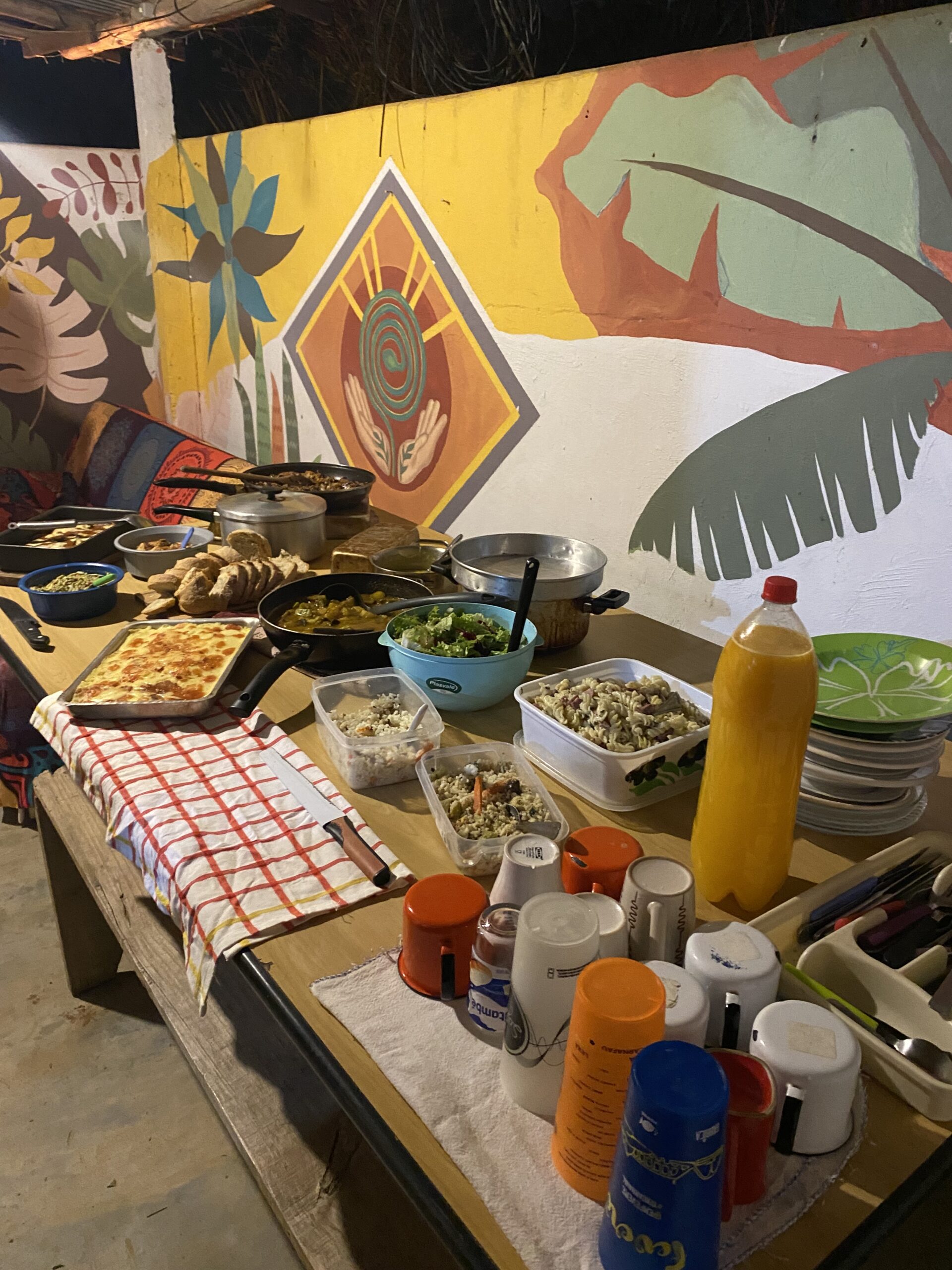
One of our favorite traditions here at Eco Caminhos is Volunteer Night. Each Thursday, all the short-term and long-term volunteers prepare a dish or a drink to share with everybody in the Eco Caminhos community.
The volunteer night is held at a variety of different places, from the Colmeia that serves as our work hub, to the volunteer houses. Wherever it’s held, volunteer night is a nice opportunity to cook for one another, try each other’s cooking, and to engage in good conversationswith people outside of work.
A zero energy farm / home produces as much renewable energy as it consumes over the course of a year, leaving the occupants with a net zero energy bill, and a carbon-free home. We have purposely installed an induction cooktop to not depend on gas and have a solar water boiler for warm water. And now we also have solar panels that produce enough electricity to cover all our energy consumption at the Colmeia, where the Bijen family lives.
We still go a step further. Today it is possible to connect more houses to one single solar system. You simply need 1 postal code for all your energy consumption location. You then make sure you put all the electrical bills on the same name. We have done this for Colmeia, the Eco Lodge (work in progress) and the 2 volunteer houses. And in the future our ecolibrium project will also be included. So this means that all electrical energy used on and around the farm is now covered by 1 solar voltaic system. In Brazil, the rule is that you can build up energy credits that you can use over the course of 5 years. It is good to benefit from this now as these rules might change in the future.
Financing your solar energy system
Also interesting to know is that you can have your solar energy system financed. It is possible that the monthly fee to pay back your financing is lower than the electricity bill. So you save money from day 1. And the best of all is once you are finished paying you only pay a small fee to the electrical company for the infrastructure and for providing continuous electricity day and night. The higher your bill and consumption, the more interesting it becomes to invest in your own solar energy system. This is because the price for a larger system is relatively cheaper than a smaller system. You may ask: what if the system breaks down? Well, you can get insurance. However, quality solar panels are difficult to break and usually function for well up to 25 years. The only expensive replacement is the inverter which needs to be replaced around 12-15 years.
Achieving one essential goal of Eco Caminhos
The achievement of becoming a zero energy home has been one of our main goals since we started in 2015. Eco Caminhos wants to become self-reliant on food, energy and building materials. Energy has now been accomplished, we still have 2 to go. We are now at a rapid pace, planting agroforests for food and wood production, producing eggs, a wide variety of vegetables and have planted over 400 fruit trees. We are already selling our surplus organic food on the market. Next year we also expect to produce milk, cheese and butter. Within 5 years we expect to become 80% self-reliant on food. Within 2 years we will also harvest our first eucalyptus wood. Our hardwood can only be harvested in 15 years but we are planting much more than we consume on the farm. In the meanwhile we are planting between 500 – 1000 trees per year.
For people who want to join our team and learn about agroforestry and bioconstruction we offer several volunteer and ecotourismprograms.